Use case – Self-Service Reporting
Wiiisdom for Tableau Self-Service Reporting
Self-service gave everyone the power to publish. It did not give anyone the means to govern what gets published. Wiiisdom lets you regain control by embedding checks into the development cycle, certifying data sources, and monitoring production environments.
Trusted by more than 600 leading companies and organizations
Dimensions that matter most for self-service reporting
What it does
From analytics chaos to trusted insights.
Govern the development cycle
Every dashboard, report and data source passes through automated checks before reaching production. Only trusted content, compliant with your SLAs and economical in resources, gets through: it is the pipeline that applies your performance and design standards, not the author who has to remember them.
Certify data sources dynamically
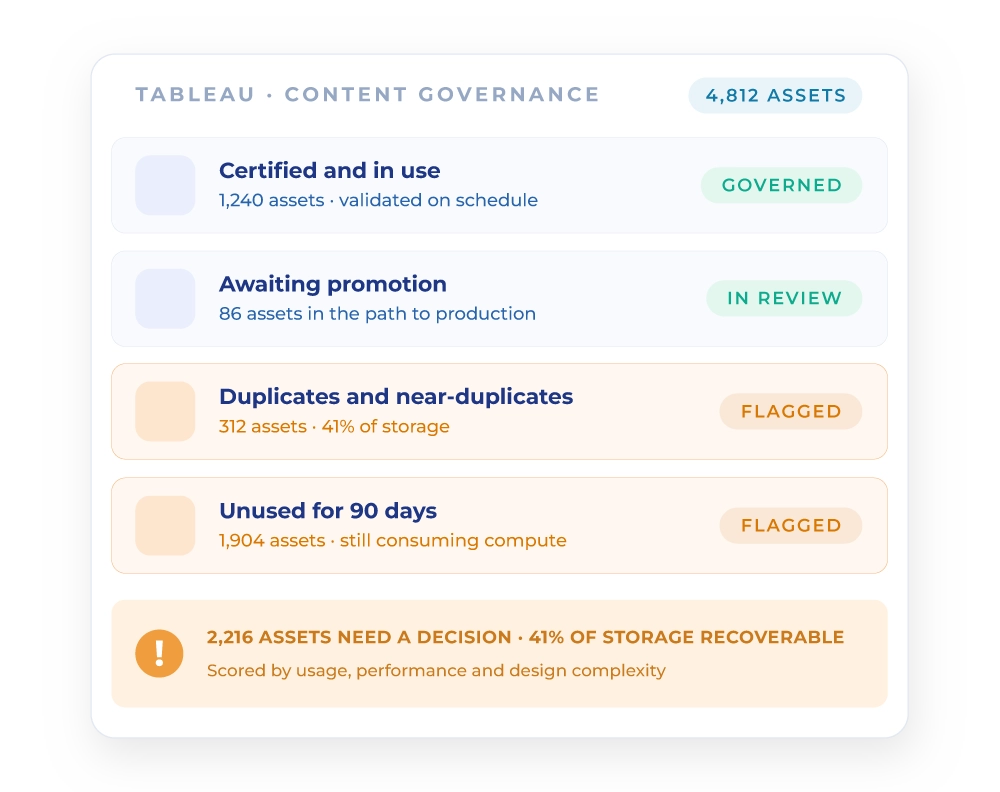
Wiiisdom continuously tests and certifies your data sources, and clearly displays which ones are reliable. Business users know at a glance what to rely on. That is what cuts short the proliferation of near-duplicate sources nobody can arbitrate between.
Keep the environment fast and available
Predictive monitoring spots and resolves issues before users are impacted. An intelligent scoring engine weighs usage, performance and design complexity, so the content that deserves attention surfaces first instead of the content that complained loudest.
Turn usage data into action
Wiiisdom applies intelligent scoring to Tableau metadata: you see who publishes, who consumes, and who drops off. Enough to celebrate your champions, support newcomers and target your training programs, rather than guessing where adoption is stalling.
Keep control without taking back the keys
Self-service does not have to mean giving up control. Embedding automated tests directly into development means your standards are applied by the pipeline rather than requested from authors: errors are caught early, conventions are enforced before content reaches production, improvement suggestions are generated, and authors keep their autonomy because it is the guardrails, not a reviewer, that decide what ships.
The payoff
From reactive, firefighting governance to proactive.
Embedded analytics inverts the stakes of a defect: the person who notices it is a paying customer, and the record of it is a support ticket. Continuous validation in production is what changes who finds it.
- Anyone can publish, and nobody can tell what is trustworthy
- Duplicate dashboards and data sources multiply, with no way to arbitrate
- Governance means a periodic clean-up nobody wants to do
- Problems reach the BI team through complaints and tickets
- Unused and heavy content keeps running, and keeps costing
- A visible certification signal separates what is trusted from what is not
- Duplicates, near-duplicates and stale content surfaced and scored automatically
- Standards applied by the promotion pipeline, on every asset, every time
- Issues detected and prioritized before users encounter them
- Waste identified at the asset level, with its usage and its cost attached
Agentic analytics governance
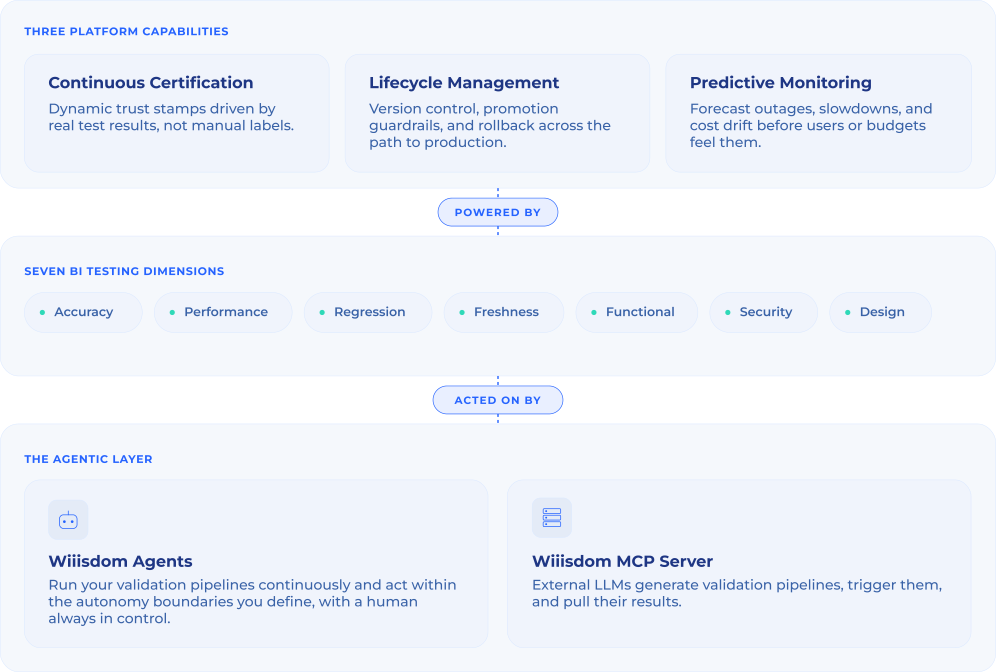
The whole platform serves this use case.
Testing is the foundation. It powers the three capabilities of the Wiiisdom platform, which agents and external AI systems act on continuously.
Keep exploring