Use case – Tableau Embedded
Wiiisdom for Tableau Embedded
When Tableau is embedded in your product, it is a piece of code to test and validate. One error and a support ticket is created, a credibility problem, and sometimes a contractual one. Wiiisdom validates your embedded content in production, before your customers do it for you.
Trusted by more than 600 leading companies and organizations
Dimensions that matter most for embedded analytics
What it does
Your customers should never be your test suite.
Get your embedded risks off the table
Whether your Tableau-embedded dashboards are internal or customer-facing, embedding multiplies their exposure, and with it the consequences of any defect. Automating their testing, especially in production, is what keeps that exposure manageable. Wiiisdom validates dashboard interactions, verifies load capacity, and confirms data accuracy through dynamic certification.
Protect your data monetization strategy
Automated validation is what protects analytics you charge for. Wiiisdom safeguards your embedded content by ensuring it is thoroughly tested before and after it ships, which enhances the customer experience, protects your reputation, and builds the trust that drives adoption and renewal.
Integrate testing into continuous delivery
Bring the lifecycle of Tableau artifacts into your product development process. Development, testing pipelines, versioning and deployment slot into your existing CI/CD, so analytics content stays aligned with the application or portal it ships inside rather than drifting away from it between releases.
Resolve issues before your customers see them
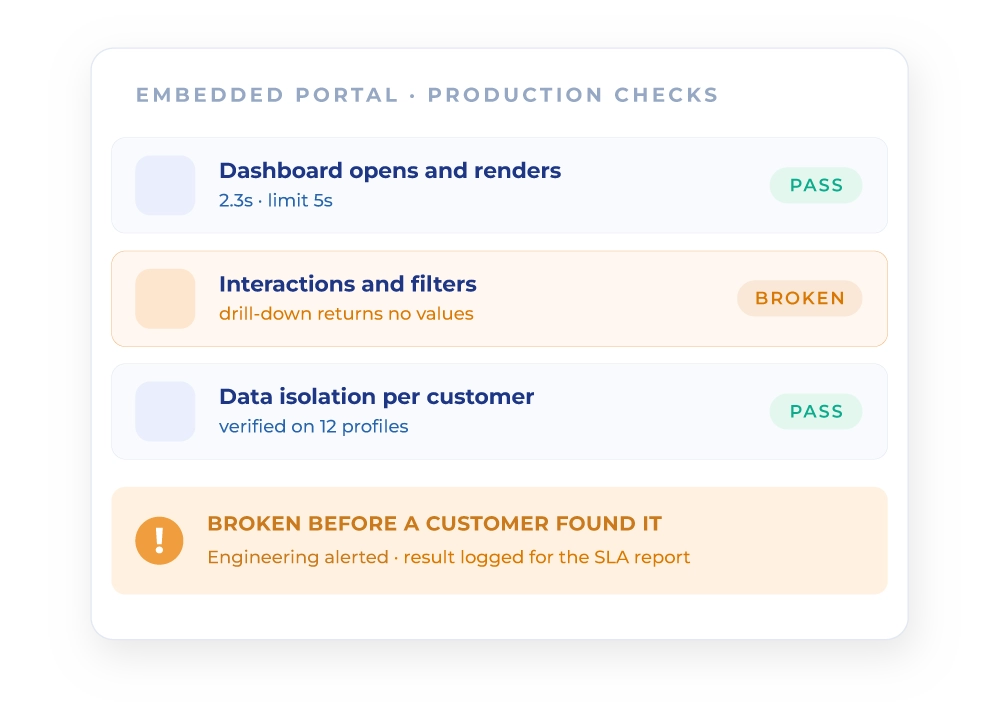
Wiiisdom checks continuously for problems in your embedded data and analytics content, so they are resolved before they reach a customer. Documenting test cases, executions and results as part of your SLA lets you demonstrate reliability instead of asserting it.
The payoff
From your customer finding the bug to you finding it first.
Embedded analytics inverts the stakes of a defect: the person who notices it is a paying customer, and the record of it is a support ticket. Continuous validation in production is what changes who finds it.
- Content is tested before release, then trusted for months in production
- A broken interaction is reported by the customer who hit it
- Load behavior across tenants is unknown until one of them complains
- SLA commitments rest on assertions, with no evidence behind them
- Analytics drifts away from the product between releases
- Embedded content validated continuously in production, tenant by tenant
- Broken interactions caught and routed to engineering before a ticket is raised
- Load and render times measured against the thresholds you committed to
- SLA reporting backed by timestamped test executions and results
- Analytics lifecycle integrated into the same CI/CD as the product
Agentic analytics governance
The whole platform serves this use case.
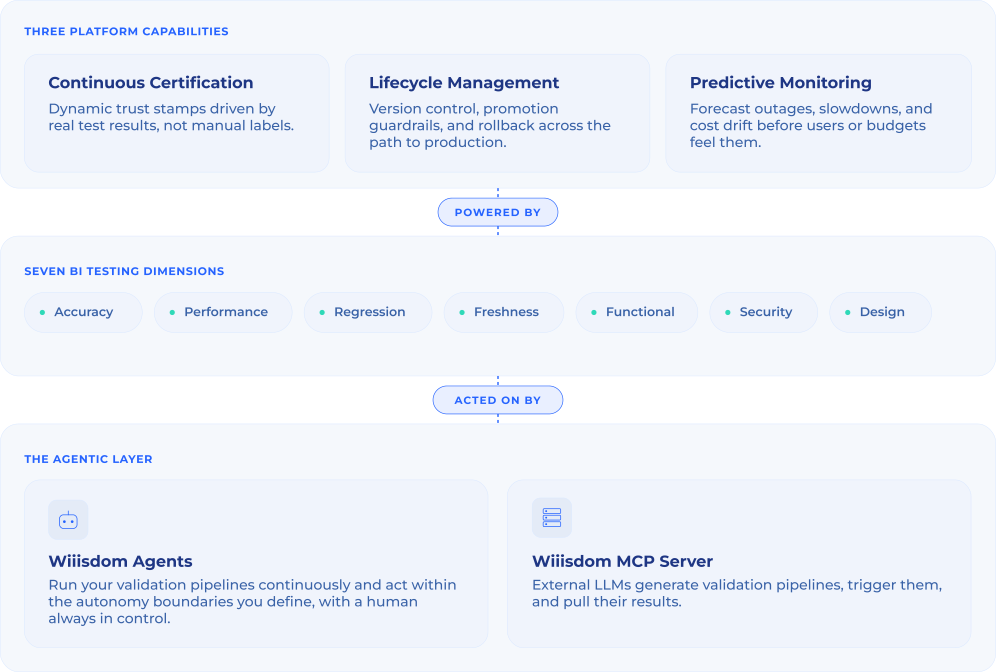
Testing is the foundation. It powers the three capabilities of the Wiiisdom platform, which agents and external AI systems act on continuously.
Keep exploring