Use case – Tableau Database Migration
Modernizing your data stack? Do it without breaking Tableau.
Moving your databases to Snowflake, Databricks or another cloud platform unlocks real capability. It also silently rewrites what every Tableau workbook returns. Wiiisdom validates the whole estate against a pre-migration baseline, and keeps the cost of the new platform under control afterwards.
Trusted by more than 600 leading companies and organizations
Dimensions that matter most for a Database migration
What it does
A migration that is technically successful and provably correct.
Ensure a smooth and documented transition
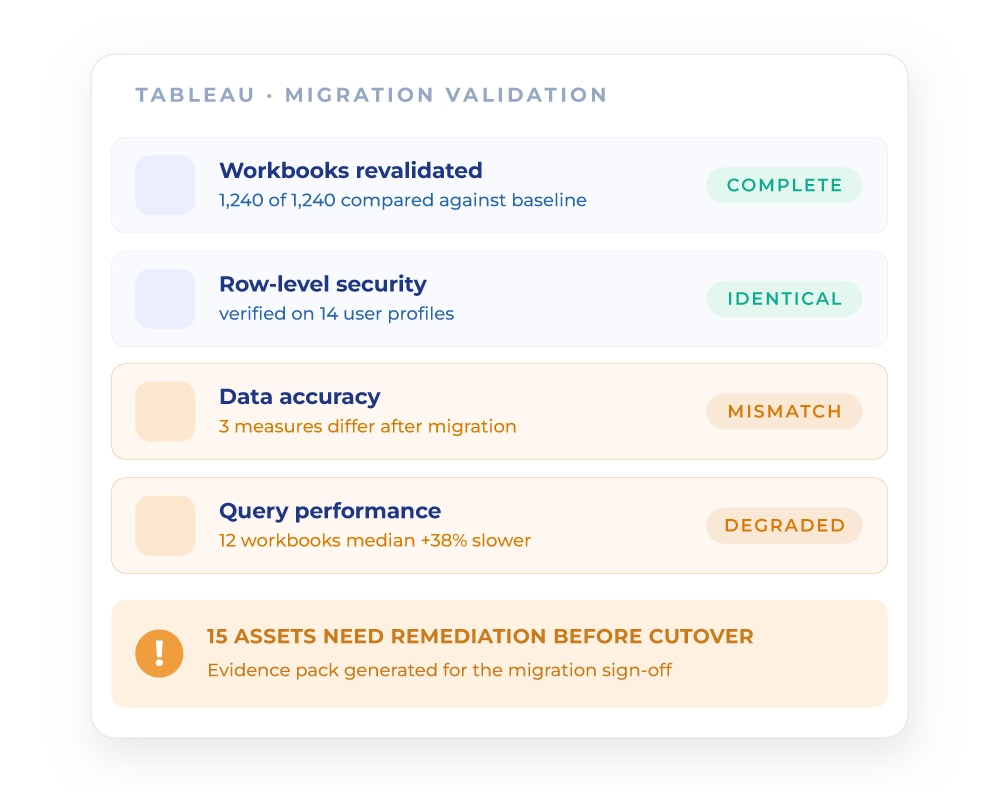
How do you guarantee Tableau still delivers reliable insights after the move? Wiiisdom regression tests your workbooks automatically to surface any unwanted discrepancy, and documents the results to certify the migration. Performance is confirmed to be at least equal, data accurate and complete, security validated, and behaviour unchanged.
Prevent unpredictable BI costs on the new platform
The cloud brings flexibility and scalability, and a bill driven by BI consumption. Wiiisdom stops heavy-footprint, poorly designed content from reaching production and generating unnecessary compute, then monitors the environment to identify the noisy neighbours, the dashboards and queries that consume disproportionate resources, before the cost spirals.
Fast-track the project, at scale
Migrating databases for Tableau should not be a slow, manual, costly ordeal. Automated testing replaces tedious manual checking and validates hundreds or thousands of assets in parallel. On an estate of any real size, testing every critical asset by hand is not an option, it is a decision to skip most of them.
Keep governing after the cutover
A migration is not finished when the connection string changes. Once you are live on the new platform, the same validation pipelines keep running: accuracy against the new source, performance against your SLAs, and design standards to hold the compute bill where you planned it.
What we test
What gets validated during a migration
Data accuracy and completeness
Values reconciled against the new source, row counts and aggregations compared to baseline.
Query performance
Response times measured on the new platform against pre-migration figures.
Security and access
Row-level security re-verified per user profile on the migrated model.
Functional behaviour
The view opens on the new source, and filters, parameters and actions behave as they should.
Design and cost footprint
Full scans, oversized extracts and heavy patterns flagged before they start billing
How it works
How a validated migration runs
Step 01
Baseline the current estate
Capture results, performance and security behaviour on the existing database, workbook by workbook. This is the reference everything else is measured against.
Step 02
Migrate and compare
Point Tableau at the new platform and re-run the suites. Wiiisdom highlights every difference in data, performance and access.
Step 03
Remediate and re-test
Work through the differences, fix, and re-run until the estate is green. Nothing goes to cutover on a partial result.
Step 04
Govern the new platform
Keep the pipelines running after go-live, so accuracy, performance and cost stay under control on the platform you just paid to move to.
The payoff
From a migration you sign off on faith to one you sign off on evidence.
Database migrations rarely fail loudly. They fail as a handful of measures that no longer match, a dozen dashboards that got slower, and a compute bill nobody forecast. All three are findable in advance.
- A sample of workbooks is checked manually, because checking all of them is impossible
- Discrepancies surface weeks after cutover, when a business user disputes a figure
- Nobody knows whether the new platform is faster or slower until users say so
- Row-level security is assumed to have survived the model change
- The cloud compute bill arrives, and no one can attribute it to specific content
- Every workbook compared against its pre-migration baseline, automatically
- Discrepancies found and remediated before cutover, not after
- Query performance measured on the new platform against the old figures
- Row-level security re-verified per user profile on the migrated model
- Heavy-footprint content stopped before it reaches production and starts billing
Keep exploring