Wiiisdom for self-service BI
Govern self-service reporting without slowing anyone down.
Freedom to build. Guardrails that keep it trustworthy and cost-efficient.
Self-service reporting solved the access problem. Every team can build dashboards and every user can answer their own questions. What it did not solve is trust. Wiiisdom validates the semantic layers users can build on, controls what reaches production, and monitors the whole environment, so adoption scales without the proliferation that usually follows.
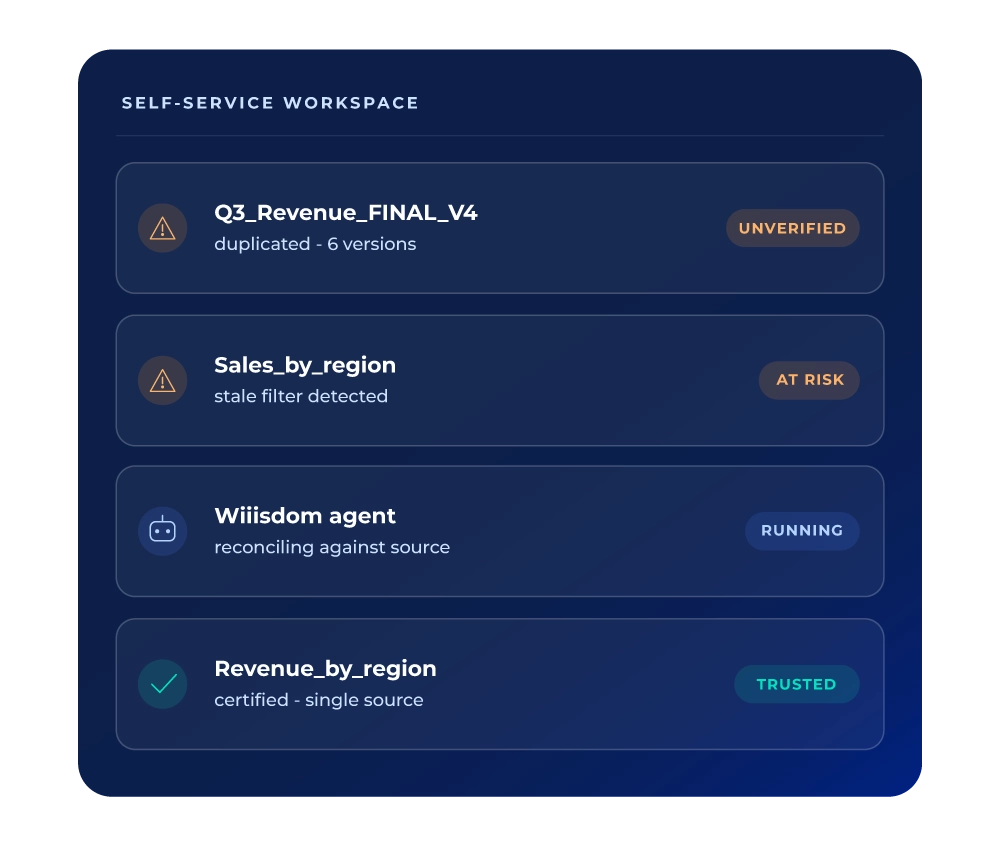
The analytics governance platform for the world’s most data-critical enterprises.
Why it matters
Self-service does not just create more content. It puts the whole platform at risk.
Self-service multiplied the number of reports and dashboards faster than any team can manage them. Every new asset adds load, refreshes, and compute, and most are built on BI models nobody validated. When those foundations are shaky, the assets on top of them inherit the problem, and the platform absorbs the cost. People should be building on a semantic layer that Wiiisdom constantly validates, not on guesswork.
Left ungoverned, that growth turns into poor designs reaching production, heavy assets degrading performance, orphaned content burning compute, and a platform that gets slower and more expensive as adoption rises. Keeping self-service healthy is a lifecycle, monitoring, and cost problem before it is anything else.
Three forms of exposure
Proliferation
Reports and dashboards multiply faster than any team can manage or retire them.
Platform strain
Heavy-footprint assets and poor designs degrade performance and risk outages.
Runaway cost
Orphaned and inefficient content keeps refreshing and billing, whether used or not.
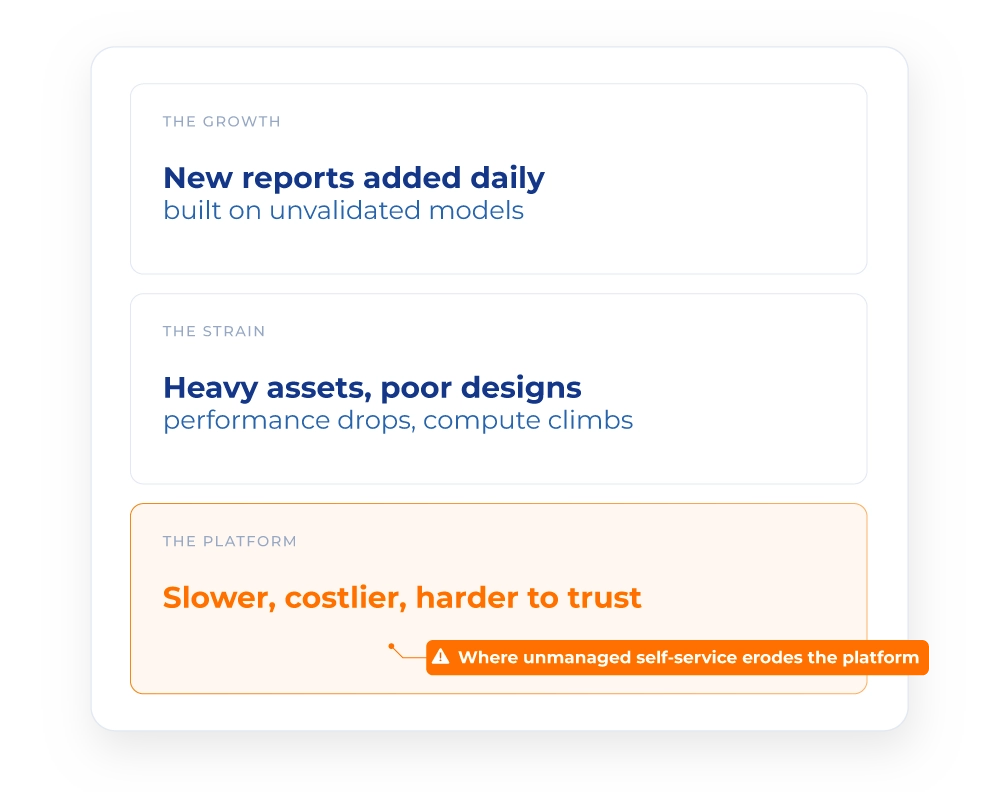
The chain: new reports added daily on unvalidated sources, heavy assets and poor designs straining the platform where other enterprise reports are critical, and a platform that ends up slower, costlier, and harder to trust. That is where unmanaged self-service erodes the platform.
What it does
Four capabilities that govern self-service at its own speed.
A reliable foundation for everything users build.
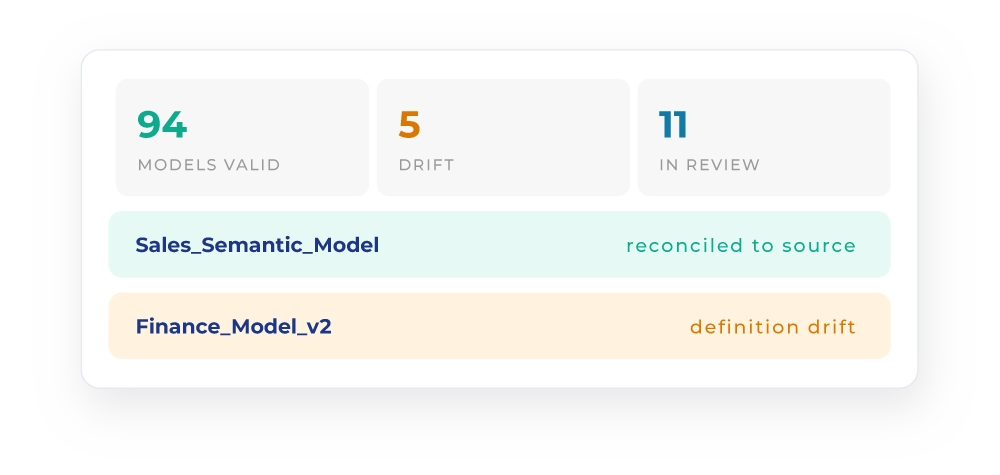
Self-service users build on shared BI models. Wiiisdom validates the accuracy of those models continuously, reconciling them against the source, so the reports and dashboards built on top start from a foundation people can actually rely on rather than from assumptions.
- Validates the accuracy of the BI models users build on.
- Reconciles model values against the underlying source of truth.
- Flags a model the moment it drifts, before new content inherits the problem.
Stop poor design from reaching production.
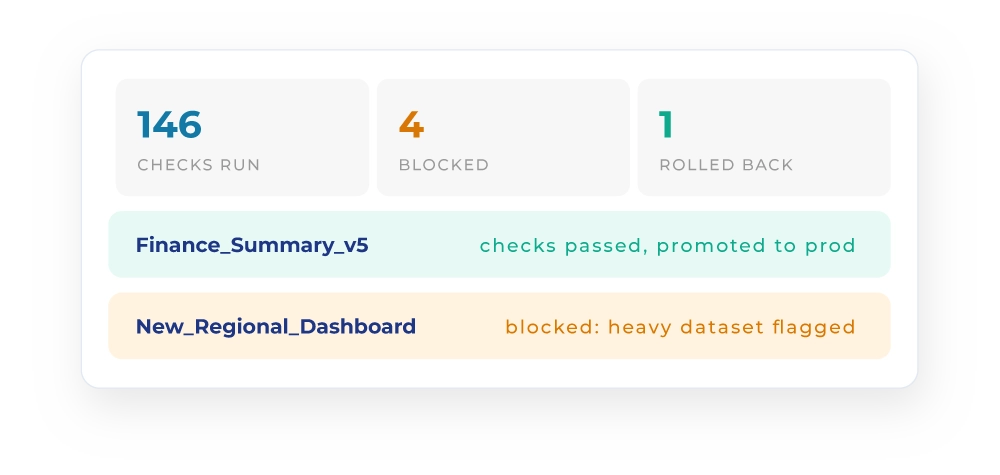
Wiiisdom brings CI/CD discipline to self-service. Design, performance, and accessibility checks run automatically in the promotion pipeline, so flawed or heavy content is caught before it ships, not after users and the platform have already paid for it.
- CI/CD pipeline with automated checks before promotion.
- Prevents poor design and heavy-footprint assets from reaching prod.
- Versioning, so a bad change can be rolled back.
Intelligent scoring that tells you where to look first.
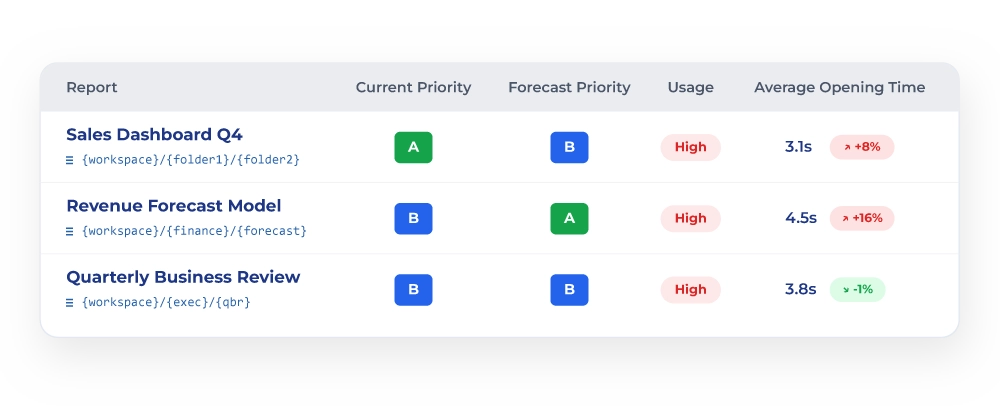
Wiiisdom scores the environment continuously, triages what matters, and recommends the next action. It catches heavy-footprint assets before they cause outages, surfaces the golden assets and data champions worth watching closely, and detects disengaged users and inconsistent behavior so you can tailor data literacy programs.
- Intelligent scoring and triage, with recommendations in context.
- Catches heavy-footprint assets to avoid outages and slowdowns.
- Spots golden assets and data champions worth monitoring closely.
- Detects disengaged users to help tailor data literacy programs.
A good foundation is not enough if usage runs wild on top of it.
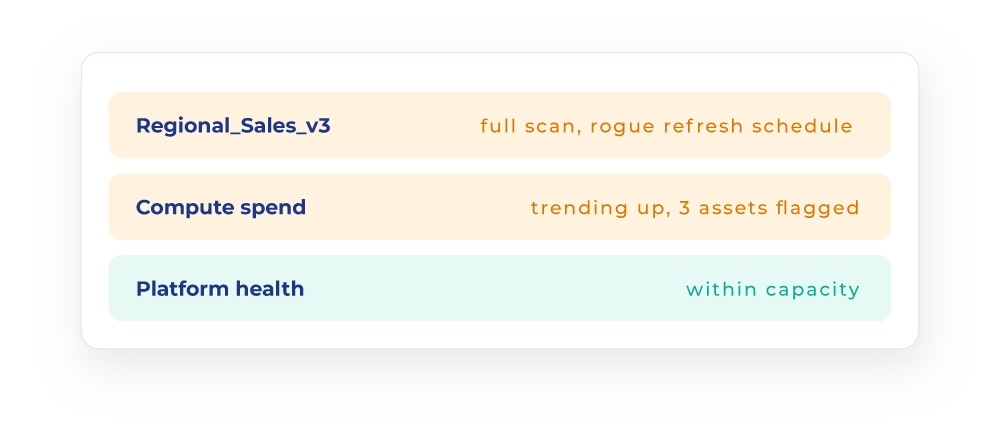
Self-service governance does not stop once content is built on validated semantic layers. Wiiisdom continuously monitors how the platform is actually used, surfacing rogue behaviors and badly designed content that quietly drain capacity. That visibility frees usage and creativity instead of restricting it, giving teams the confidence to explore, build, and innovate while platform health and cost stay in your control as self-service scales.
- Detects rogue behaviors and out-of-best-practice usage as they happen.
- Flags badly designed content that drains compute and degrades performance.
- Protects platform health and keeps compute cost under control as usage grows.
“Build a comprehensive monitoring solution to identify and diagnose system performance challenges or inappropriate user behaviors. Accompany this with follow-up processes to reinforce governance policies.”
GARTNER is a registered trademark and service mark of Gartner, Inc. and/or its affiliates in the U.S. and internationally and is used herein with permission. All rights reserved. Gartner does not endorse any vendor, product or service depicted in its research publications, and does not advise technology users to select only those vendors with the highest ratings or other designation. Gartner research publications consist of the opinions of Gartner's research organization and should not be construed as statements of fact. Gartner disclaims all warranties, expressed or implied, with respect to this research, including any warranties of merchantability or fitness for a particular purpose.
The payoff
From BI chaos to scalable adoption
The symptoms of ungoverned self-service analytics are familiar. Governed well, every one of them flips into a reason adoption grows instead of stalling, giving teams the trusted, monitored, and reusable BI foundation they need to become AI Analytics ready.
- Too many dashboards covering the same topic
- No clear signal of what users should trust
- Low adoption despite BI investment
- Performance issues caused by uncontrolled content growth
- BI teams stuck in reactive, firefighting mode
- Validated, reusable BI models cut duplication at the source
- A clear validation signal on the foundation users build on
- Trusted content that earns confident, growing adoption
- Heavy-footprint assets caught before they degrade performance
- Intelligent scoring that moves teams from cleanup to prevention
What good governance enforces
Structure that scales with self-service, not against it.
Wiiisdom brings four controls to distributed analytics, none of which require taking tools away from your users.
Validation
Validates the BI models that are foundational to everything users build in self-service.
Promotion
Guardrails and approvals before content moves into production.
Versioning
A full history and the ability to roll back a change that went wrong.
Monitoring
A full history and the ability to roll back a change that went wrong.
Customer story
“Wiiisdom solutions have allowed us to introduce a governance layer that balances flexibility with control, ensuring data quality, consistency, and compliance without stifling self-service innovation.”
SSA Platforms Managing Director, Fortune 500 company in Banking
How it fits
Get up and running quickly.
01
Set rules
Define your standards for design, performance, and accessibility that content must meet.
02
Set tolerance
Decide how strict each rule is, and what passes, warns, or blocks promotion.
03
Run
Wiiisdom runs the checks automatically in your CI/CD pipeline, before content reaches production.