Use case – Self-Service Reporting
Wiiisdom for Power BI Self-Service Reporting
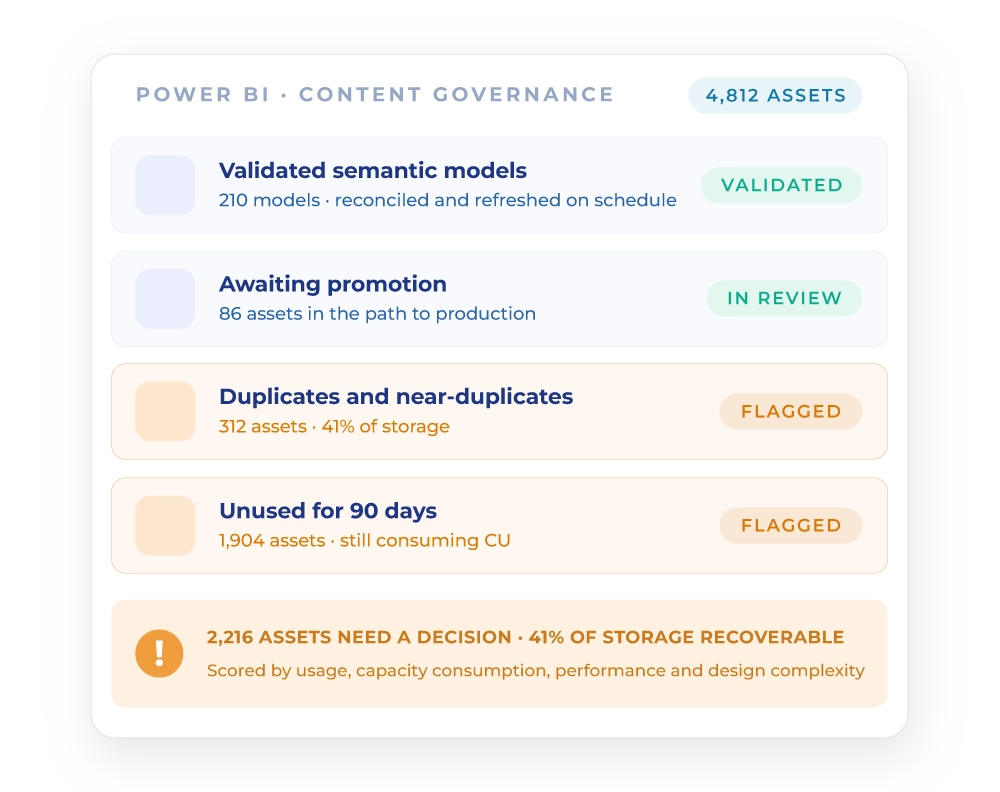
Self-service gave everyone the power to publish. It did not give anyone the means to govern what gets published. Wiiisdom lets you regain control by embedding checks into the path to production, validating the semantic models, and monitoring production workspaces continuously so duplicates, abandoned content and runaway capacity consumption surface before they become a clean-up project.
Trusted by more than 600 leading companies and organizations
Dimensions that matter most for enterprise reporting
What it does
From analytics chaos to trusted insights.
Govern the path to production
Every report and every semantic model passes through automated checks before reaching a production workspace. Only trusted content, compliant with your SLAs and economical in capacity, gets through: it is the pipeline that applies your performance and design standards, not the author who has to remember them. Promotion from Dev to Test to Prod runs through approval gates, with your ticketing system and Azure DevOps in the loop.
Give every author a trusted foundation
Self-service reports are built fast, revised often, and rarely reviewed, so the leverage is not in policing the reports: it is in the semantic models underneath them. Wiiisdom validates those models continuously, reconciling them against the source of truth, testing calculation logic through DAX queries, and checking that refreshes actually landed. Models that pass carry a visible validation state, and it flips the moment they drift. Authors build on foundations whose state is known, and one validated model replaces the dozen private versions people build when they cannot tell which one is right.
Keep the environment fast and available
Predictive monitoring spots and resolves issues before users are impacted. An intelligent scoring engine weighs usage, capacity consumption, performance and design complexity, so the content that deserves attention surfaces first instead of the content that complained loudest. Noisy neighbors and high-footprint reports are identified before they throttle a shared capacity.
Control what self-service costs to run
Self-service does not just multiply content, it multiplies consumption: duplicated models each refresh on their own schedule, abandoned reports keep refreshing, and heavy designs pay for themselves in capacity units on every render. Wiiisdom attributes consumption at the asset level and blocks costly content before promotion, so you can retire what nobody opens and stop paying for what should never have shipped.
Feed your training programs
Wiiisdom applies intelligent scoring to Power BI metadata: you see who publishes, who consumes, and who drops off. Enough to celebrate your champions, support newcomers and target your training programs, rather than guessing where adoption is stalling.
Keep control without taking back the keys
Self-service does not have to mean giving up control. Embedding automated tests directly into the path to production means your standards are applied by the pipeline rather than requested from authors: errors are caught early, conventions are enforced before content reaches production, AI recommends the right fix in context, and authors keep their autonomy because it is the guardrails, not a reviewer, that decide what ships.
The payoff
From reactive, firefighting governance to proactive.
In a self-service environment, manual review does not scale and never did. Wiiisdom governs by exception: everything is validated continuously, and only what fails needs a human.
- Anyone can publish to a workspace, and nobody can tell what is trustworthy
- Duplicate reports and semantic models multiply, with no way to arbitrate
- Governance means a periodic clean-up nobody wants to do
- Problems reach the BI team through complaints and tickets
- Unused and heavy content keeps running, and keeps consuming capacity
- A visible validation state on semantic models separates trusted foundations from the rest
- Duplicates, near-duplicates and stale content surfaced and scored automatically
- Standards applied by the promotion pipeline, on every asset, every time
- Issues detected and prioritized before users encounter them
- Waste identified at the asset level, with its usage and its capacity cost attached
Agentic analytics governance
The whole platform serves this use case.
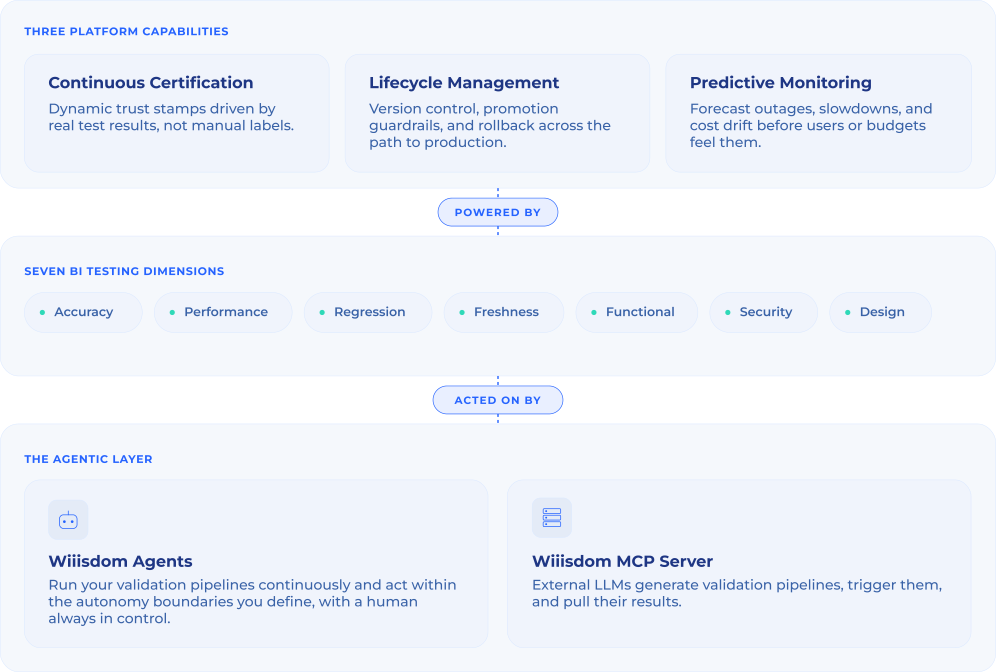
Testing is the foundation. It powers the three capabilities of the Wiiisdom platform, which agents and external AI systems act on continuously.
Keep exploring