
You’re Closer to AI Analytics Than You Think, and Further Than You Realize
Closer, because the foundation already exists in your BI. Further, because without governance, AI just democratizes approximation.
A point of view for CDAOs, VPs of Data & Analytics, and BI leaders.
By Sébastien Goiffon, CEO, Wiiisdom

The question on every board agenda
The question on the agenda of nearly every board and executive committee today is not whether to use AI on company data. That debate is over. Every organization wants it, and most are already asking specifically about AI Analytics: letting people query their data in natural language and get answers back. The real question is what the strategy should be to get there reliably.
Beneath that sits the question that ultimately shapes every strategy: can we trust what these systems tell us, and how quickly can we reach answers we can actually act on?
Two roads lead to AI Analytics. The first reuses what you already have: the dashboards, reports, and semantic models running across your BI environment today. The second places AI directly on top of data, which in practice means rebuilding the reporting logic, the semantic layer, and the metric definitions from the ground up.
This is where strategy deserves a hard look. Your organization has spent years building dashboards, semantic models, and KPI definitions. That is years of institutional knowledge encoded into the exact layer where data becomes a decision: how a metric is calculated, which filter applies to which entity, what “revenue” actually means in your context.
So before committing to tearing that down, here is the question every analytics leader should ask: why would you discard it?
I don’t believe in magic. I believe in trust. This is a point of view about which road to take, and why it matters now.
The model is only as good as its context
Behind every vendor’s pitch sits a truth most prefer to leave unspoken: an AI system does not create truth. It exploits the context it is given. If your metrics are inconsistent, if your dashboards are only partially reliable, if your transformations aren’t controlled, AI won’t fix any of that. It will amplify it and deliver the result with the confidence of certainty.
The risk was never that AI gets things wrong. The risk is that it gets things wrong with conviction, at scale, and that no one notices.
The evidence is in. According to Salesforce’s State of Data and Analytics report (November 2025, surveying 3,800 analytics and IT decision-makers across 18 countries), 89% of data and analytics leaders with AI in production say they have already experienced inaccurate or misleading AI outputs. Nearly nine out of ten. This isn’t a skeptic’s warning; it’s the operating reality of the leaders furthest along.
The cautious aren’t alone in saying so. Anthropic, which automates 95% of its own analytics with its Claude models, states it plainly: the problem is neither the code nor the model, but context and verification. Point an AI at a data warehouse, their teams write, and you create a “false sense of precision.” When the pioneers of AI name trust as the real obstacle, it is time to listen.
One constant runs through every BI wave
The history of business intelligence is a history of waves: reporting, then dashboards, then self-service, and now AI Analytics. Each time, the death of the previous wave was announced. Each time, the prediction was wrong. Self-service did not kill reporting. AI will not kill BI. These waves do not replace one another; they accumulate, widening the circle of users and multiplying the use cases.
But as they accumulate, they amplify risk: more users, more content, more data exposure, more cost, more regulation. One constant runs through all of them without weakening: the need to trust what you see before you decide. That is the DNA of this discipline. AI does not erase it. AI makes it vital.
Your existing analytics layer is your best asset
The shortest path to AI Analytics does not run through reconstruction. It runs through mastering what you already have. The alternative is tempting: put AI directly on the data, leveraging platforms like Databricks or Snowflake, or via a new semantic layer rebuilt from the ground up. But rebuilding everything upstream usually means ignoring what exists rather than building on it, and it commits you to a long, expensive program that widens the gap between architectural theory and the way people actually work. Your executive committee is not asking for AI in three years. It is asking for it now.
That is why this layer matters so much. In most organizations, business usage rests heavily on dashboards, reports, semantic models, and metrics refined over years, and these are the exact surfaces where AI is now landing: Copilot in Power BI, agents in Tableau, Gemini in Looker… Living, distributed, and closest to the business user, this layer is the operational reality of the enterprise. It can feed new AI use cases directly, precisely because it already encodes what the data means to the person who acts on it.
The problem was never only in the data. It lies in how that data is materialized, interpreted, and consumed, and that is exactly where the credibility of any AI Analytics initiative is won or lost. Govern that layer well, and it becomes the fastest and safest on-ramp to AI. This is where organizations should move with urgency: AI on top of governed BI delivers value quickly, creates visible adoption, and builds the trust infrastructure the enterprise needs. It does not mean abandoning AI directly on data, through initiatives such as Cortex or Genie. But starting with the governed BI layer gives the enterprise time, confidence, and a proven adoption path while those deeper foundations mature.
Data Governance and Analytics Governance are not the same thing
This distinction is the heart of the matter, and it is routinely overlooked.
Governing analytics has never meant slowing teams down. It means guaranteeing that what the enterprise decides on is validated, reliable, traceable, continuously monitored, and certified. It means securing what we call the last mile on the data journey: the precise point where data becomes decision.
Data Governance stops too early. It is indispensable: it ensures clean, trustworthy data at the source. But clean data does not guarantee a correct decision. The first thing anyone does inside a report or dashboard is transform the data: they merge, they hard-code filters, they add variables and parameters. Every one of those moves introduces risk that Data Governance cannot see. A perfectly governed dataset can still produce a wrong number on the screen a CFO is reading.
That gap, the reliability of the decision layer itself, is the blind spot. Closing it is the work of Analytics Governance, in continuity with Data Governance, all the way to the point of decision.
Why this is the decisive advantage
Analytics Governance works with existing usage, not against it. Where a full rebuild forces a rupture, Analytics Governance enables progressive evolution: business teams keep their tools, but operate inside an environment where quality, consistency, traceability, and costs are genuinely controlled. Trust stops resting on implicit conventions and starts resting on concrete mechanisms.
This is what turns governance from a support function into a strategic lever. It does not replace data Governance; it extends it, closing the one blind spot that determines whether AI Analytics is trustworthy in production or merely impressive in a demo.
There is also a cost argument, and it compounds quickly. Every natural language query fired against raw cloud infrastructure is a compute event. Success makes the bill grow, not shrink. The governed BI layer acts as a buffer: reusable, refreshed content that absorbs demand without regenerating it from scratch. Governing what already exists is not only the fastest and safest path to AI Analytics. It is the most economical.
This is not an abstract idea. At Tableau Conference 2026, Jeff Quinn, Sr Manager R&D Business Technology at Pfizer summarized what governance-driven partnership looks like in practice:
“Wiiisdom didn’t just give us a tool, they gave us a framework that grew with us, adapting to every challenge in our 18,000-dashboard migration.”
Scale is exactly where the blind spot Data Governance cannot see becomes unavoidable, and where the discipline described in this piece stops being theoretical.
Governance has to become agentic
One conviction leads to a second, more demanding one. AI does not just add usage. It makes usage explode: infinite questions, proliferating content, costs that climb at the speed of success. At that scale, governing by hand, even with the best tools, becomes impossible. Analytics Governance, long sufficient, is no longer enough.
It has to change in nature, operating at the speed of the systems it oversees. It has to become agentic.
This is the path Wiiisdom has chosen, becoming the first vendor to build an Agentic Analytics Governance Platform. The idea is simple; the consequences are profound: agents equipped with expertise, automation, and context continuously watch over the enterprise’s analytics. Agents that:
- alert before an error propagates;
- recommend the right correction, because they understand the system’s real context;
- act within the bounds of autonomy the enterprise sets, with a human always in control of sensitive decisions, and every action traced.
This is no longer about certifying some dashboards from time to time. It is about making every insight reliable, explainable, and reusable, in a world where other systems will interpret it, recombine it, and sometimes act on it. This living, observable, executable governance is what separates AI Analytics that dazzles in a demo from AI Analytics that holds up in production.
A decision guide: where does your organization actually stand?
Most analytics leaders overestimate their maturity because they conflate the foundation with the finish line. There are four rungs on this ladder, and they are sequential:
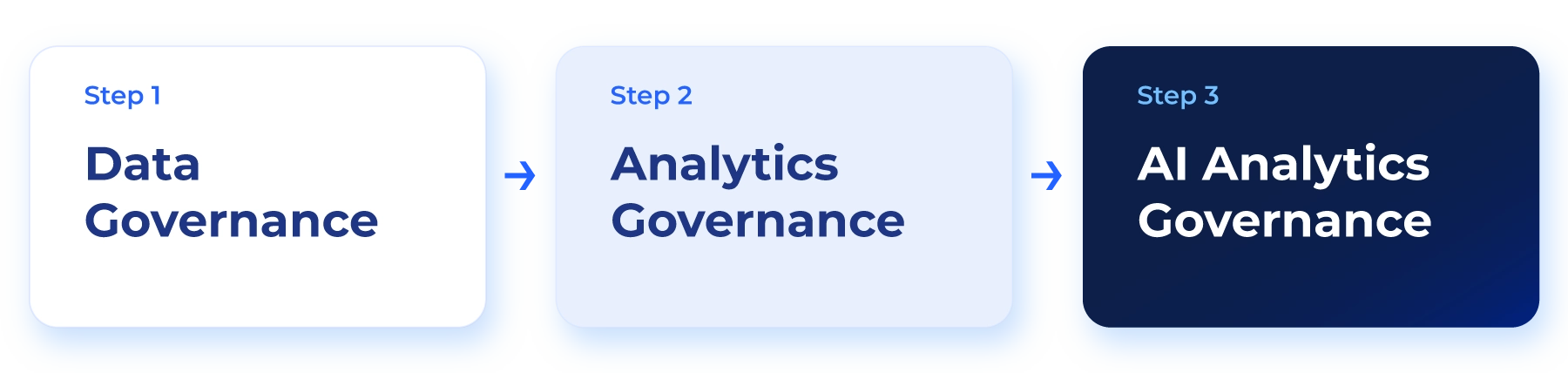
Climbing it means moving in sequence. Data Governance delivers clean, trustworthy data at the source, largely in place at big organizations, and the foundation rather than the finish. Analytics Governance comes next, in two moves: proactive control of what enters production before it reaches users, and continuous monitoring of what is already live as new content keeps arriving.
Agentic Analytics Governance carries both to machine speed and enterprise scale, where manual control no longer holds. Clearing these rungs does not hand you AI Analytics governance; it earns you the right foundation for it. The final step, governing the AI layer itself, is what decides whether the answers an AI or an agent draws from your analytics are reliable, traceable, and safe to act on.
Most organizations know exactly which rung they are standing on. The harder question is whether they are treating it as the destination or the starting point. That gap, not data quality, is what decides whether an AI Analytics initiative proves trustworthy in production. Name it honestly, and you have your priority.
The decision
We are entering an era where everyone in the enterprise becomes an analyst. That is a remarkable promise. But without Analytics Governance, AI does not democratize analytics; it democratizes approximation, at a speed and scale we have never seen.
The organizations that succeed will not be the ones with the most sophisticated stack. They will be the ones that made their analytics reliable and governed enough to be reused with confidence by data consumers and by agents alike. In other words, the ones who understood that the fastest path to AI runs through mastery of what already exists, not reconstruction of it.
The true scarcity is no longer access to data. It is trust in the decision.
Governance stops being a support function. It becomes the strategic advantage. And in the age of agents, it can no longer be content to observe. It has to act.
AI Analytics will not take a single shape. The path through governed BI is the fastest, safest, and most efficient starting point, and the one where value is already reachable today. The path through AI directly on data is real, rising, and will matter. For most organizations, the question is not which road to take eventually. It is which one to take first. Our answer is clear. And we are building to be there when the second road arrives too.
The real question for your organization is not whether you will adopt AI Analytics. It is whether you will govern it before or after the first incident.
