
Trusted Agentic Analytics
The Golden Questions Playbook for Agentic Analytics
How to define, own, and run the test set that decides whether your AI answers can be trusted.
Golden questions are the last control. A governed analytics foundation is what prevents most failures in the first place.
Why change
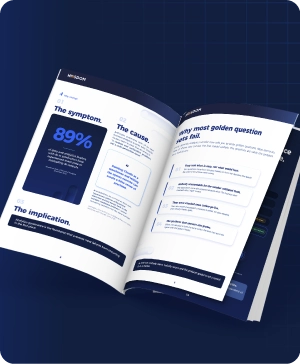
The symptom
of data and analytics leaders with Agentic Analytics in production say they have already experienced inaccurate or misleading AI outputs.
Salesforce, State of Data and Analytics, Nov 2025, 3,800 decision-makers, 18 countries
The cause
Anthropic automates 95% of its own business analytics queries with Claude. Its data team is clear that accuracy is “a context and verification problem, not a code generation issue.”
Pointing Claude at a warehouse and letting the agents execute can create a false sense of precision.
And definitions do not hold on their own: "governance without enforcement otherwise quickly decays back to the multiple candidates problem", several competing definitions for the same number.
Anthropic, How Anthropic enables self-service data analytics with Claude, June 2026
The implication
Golden questions are the last control.
Analytics governance is the foundation that prevents most failures from occurring in the first place.
Why most golden question sets fail.
Every agentic analytics vendor now tells you to write golden questions. Most teams do. Few of those sets survive the first model update. The questions are rarely the problem. Four habits are:
They test what is easy, not what would hurt.
The questions come from the data model, not from the decisions that would be costly if the answer were wrong.
Nobody accountable for the number validated them.
The data team wrote the expected answers alone. The business never checked what "right" means.
They were checked once, before go-live.
Then the model is upgraded, a measure is edited, the data refreshes, and nobody checks again.
The platform that answers also grades.
Often with another AI from the same vendor. The team then tunes the agent until that judge is happy.
A test set nobody owns, nobody reruns and the producer grades is not a control. It is a demo.
On a governed foundation: Define. Own. Run. Judge.
Golden questions are not a dataset. They are a control. Like any control in finance or quality, they need a scope, an owner, a cadence and someone independent to check them.
-
01
Define · what to test
Start from the decisions AI answers feed, tier them by risk, and write each question so it can only pass for the right reason.
-
02
Own · the right answer
The business owner of each number validates the expected answer. People do this when a question is created, and again when a definition changes.
-
03
Run · when to test
Automatically, on every change that can move an answer, plus random samples of real production questions.
-
04
Judge · pass or fail
On every run, an independent check compares the agent's answer with the validated expected answer, outside the platform that answers. Same answer, same verdict. AI can help test. The verdict needs an owner.
The foundation under all four
Code goes through review, tests, and staged deployment before it reaches a user. Dashboards, metric definitions, and semantic models – the assets your agents read – usually go through none of it. Treat them as code: tested, gated before production, certified continuously. It prevents most failures. Golden questions catch the rest.
Define · step 1
Start from decisions, not from tables.
A golden question earns its place because of the decision it protects. Build a decision inventory before writing a single question.
| Decision | Number behind it | Who acts | Cost if wrong |
|---|---|---|---|
| Quarterly results presented to the board | ARR, NRR, gross margin | CFO, board | A board meeting spent debating whose number is right |
| Regulatory filing | Risk and capital ratios | Compliance | Sanction, audit finding |
| Pricing change | Margin by product | Pricing committee | Lost margin at scale |
| Weekly operations | Backlog by site | Ops managers | Wrong staffing |
| Self-service exploration | Ad hoc questions | Analysts | Wasted time |
The leader’s question
Ask each executive: which three numbers would hurt you most if an agent got them wrong? Their answers are your first golden questions.
Define · step 2
Tier every decision by risk.
A bolt for a garden chair and a bolt for landing gear do not get the same inspection. Neither should a board number and an ad hoc question.
-
Tier 1 · Critical
Board, regulatory, financial reporting
- Every number the decision uses has a golden question
- Several phrasings per question
- Reconciled against an independent source
- No failure tolerated before release
- A named business owner validates the reference
-
Tier 2 · Operational
Operational reporting, recurring management questions
- Golden questions on the KPIs that drive action
- Automated runs on every change
- Regular random sampling of real questions
- Threshold agreed with the business
-
Tier 3 · Exploration
Self-service, ad hoc analysis
- A small set covering core definitions
- Automated runs on every change
- Occasional random samples
- Clearly labelled as not certified
Start here: cover Tier 1 completely before touching Tiers 2 and 3. Depth where it matters beats volume everywhere.
Define · step 3
Write questions that can only pass for the right reason.
| Golden Question · Tier 1 | |
|---|---|
| Intent | Net revenue retention for the last closed quarter. |
| Phrasings | "What was NRR last quarter?" · "How much did existing customers grow?" · "Net retention Q3?" The way executives really ask. |
| Expected answer | A governed reference query recomputed at every run with a tolerance. Not a number frozen in a spreadsheet. |
| Definition traps | Fiscal vs. calendar quarter, churned accounts included, currency, intercompany excluded. |
| Negative case | "NRR next quarter?" The agent must decline or ask, never invent. |
| Owner · version | Validated by VP Finance · v3, revalidated after the churn definition change. |
Use AI to draft phrasings and spot definition traps. It is fast at it. The expected answer stays human and governed.
Own · the right answer
Whoever builds the agent never writes its exam.
The owner decides what the right answer is before any test runs. Finance separates who orders from who pays. Apply the same segregation of duties to the reference your agents are tested against.
| Role | Owns | Never |
|---|---|---|
| Business owner of the number | Validates the expected answer and its definition | Leaves that validation to the data team |
| BI team | Writes questions, phrasings, and reference queries | Builds or tunes the agent it tests |
| Agent builders | Fix what fails from the evidence returned | See, edit, or tune against the test set |
| CDAO or governance lead | Approves tiers and go-live thresholds | Waives Tier 1 failures |
No one in this table grades each answer. On every run, the verdict comes from an independent, automated check. That is Judge.
Change control
Version the test set like code. When a business definition changes, the expected answer is revalidated before the next run, and the history stays auditable.
Run · when to test
A certification describes a moment. Re-earn it continuously.
No team can review at agentic volume. Automation runs the volume. Humans handle what fails.
Run · the full set when
The model is upgraded
by your vendor, often without notice
A semantic model ships
before release, as a gate, not after
Agent instructions change
prompts, scope, sources, tools
The data refreshes
Tier 1 on every refresh, others on schedule
And sample what nobody planned
Pull a random sample of real questions from production every week and validate them too. The absence of an alarm is not evidence of quality.
Keep the expected answer live
rerun the governed reference query in the same cycle, so a data refresh never creates a false alarm and a real drift never hides behind one.
Judge · pass or fail
An AI judge gives an opinion. You need evidence.
The owner sets the right answer. The judge decides, on every run, whether the agent’s answer matches it.
AI judge · same platform
0.92
“The answer appears consistent with the revenue data and interprets the question correctly.”
Independent check
- Expected
- 108%
- Answer
- 108%
- Verdict
- ✓ Pass
Compared against a governed reference: value, filters, period.
The explanation is not evidence either. When reasoning models used a hint to reach an answer, they mentioned it only 25% (Claude 3.7 Sonnet) to 39% (DeepSeek R1) of the time.
Anthropic, Reasoning Models Don't Always Say What They Think, April 2025
Takeaway: reading an AI judge’s reasoning feels like validation. It is not. Only a result you can rerun is evidence.
Four tests for your judge
-
AI can test
Draft phrasings, generate edge cases, triage failures.
-
It can't attest
Decide pass or fail on its own opinion, or rewrite the reference it is judged against.
The tooling gap
Why existing AI evaluation tools fail BI leaders.
They were built to help engineers improve the AI. None of them answers the question your CFO asks: is this number right?
| Tool | What it measures | What it misses |
|---|---|---|
| LLM judge | Similarity and plausibility against a reference | Whether the number is right. Shares the biases of the model it grades |
| RAG evaluation | Whether the right context was retrieved | Whether the calculation on that context is correct |
| Prompt testing | Prompt quality and robustness | The data and semantic models changing underneath |
| Platform-native evaluations | The vendor's own agent, on its own platform | Independence, and every other platform you run |
 |
Business answer correctness, against a governed reference and the health of the BI foundation the answer was built from | |
They test the AI.
Wiiisdom tests the answer, and governs what it is made of.
Act on the verdict
Give the check the power to stop.
Toyota’s looms stopped the moment a thread broke, so one operator could run many machines. Apply the same split to AI answers.
-
Machine
Detect
Every run, every change
-
Machine
Stop
Block the release, flag the answer
-
People
Fix
From the evidence returned
-
People
Root cause
Model, metadata or definition?
Go-live gates by tier
Tier 1
No failure on Tier 1 questions. A named business owner validates the golden questions before the agent answers on that topic.
Tier 2
Score above the threshold agreed with the business. Failures fixed within an agreed delay.
Tier 3
Core definitions pass. Answers labelled as exploration, not certified.
A model cannot be held accountable. That is why the Tier 1 reference stays human. The verdict on each run can then be automated.
Report
Answer the board before it asks.
Three questions will come: who checked, how often, and what happened when it failed. One page should answer all three.
| Agent | Tier 1 pass | Tier 2 score | Drift · 30 days | Verdict |
|---|---|---|---|---|
| Finance | 24 / 24 | 96 | 2, fixed | Certified by agent |
| Sales | 17 / 18 | 88 | 4,1 open | Blocked, fix proposed |
| Supply chain | 12 / 12 | 91 | 1, fixed | Certified by agent |
Golden questions are defined with the business and reviewed with it from time to time. On every run, the verdict comes from the agent, not from a business sign-off. Illustrative values.
Four indicators to track
Coverage
Share of production AI answers covered by business-validated golden questions, by tier
Gate effectiveness
Failures stopped before they reached a user or triggered an action
Time to fix
From detection to a corrected answer, re-certified by the agent
Agents under gates
Number of agents live with evaluation and release gates, quarter over quarter
A board does not accept an AI’s opinion. It accepts evidence, checked against a reference the business owns.
Our vision · agentic analytics governance
Not another tool. An intelligence that keeps your agents reliable, at scale.
01 · It knows when to evaluate.
Model update · Data refresh · Prompt change
| Changes | Result |
|---|---|
| Manual | Under-runs |
| Reactive (after a user complains) | Too late |
| Scheduled | Over-runs, still misses |
|
Right tests, right moment |
02 · It does not stop at catching drift.
The most complete governance platform for BI and Agentic Analytics.
Governs the BI foundation andevaluates the agents built on it. Independent of Power BI, Tableau, Fabric, and SAP BusinessObjects.
Your first 30 days · 15/15
Start Monday. Show evidence in a month.
Week 1
Build the decision inventory with three executives. Tier every decision.
Week 2
Write Tier 1 golden questions and traps. Get every expected answer validated by the business.
Week 3
Automate the runs outside the platform, on every trigger.
Week 4
Set the go-live gates by tier. Send the first scorecard to leadership.
Wiiisdom
Your independent governance platform for BI and Agentic Analytics.
-
Govern the BI layer
Semantic layers, reports and dashboards, tested and certified before your agents read them.
-
Monitor your agents
Scored continuously against the golden questions you define with the business.
Two pieces of the same control: a governed BI layer and evaluated answers.