The Value in BI Is Moving: What Agentic Analytics Can’t Do Alone
Summary:
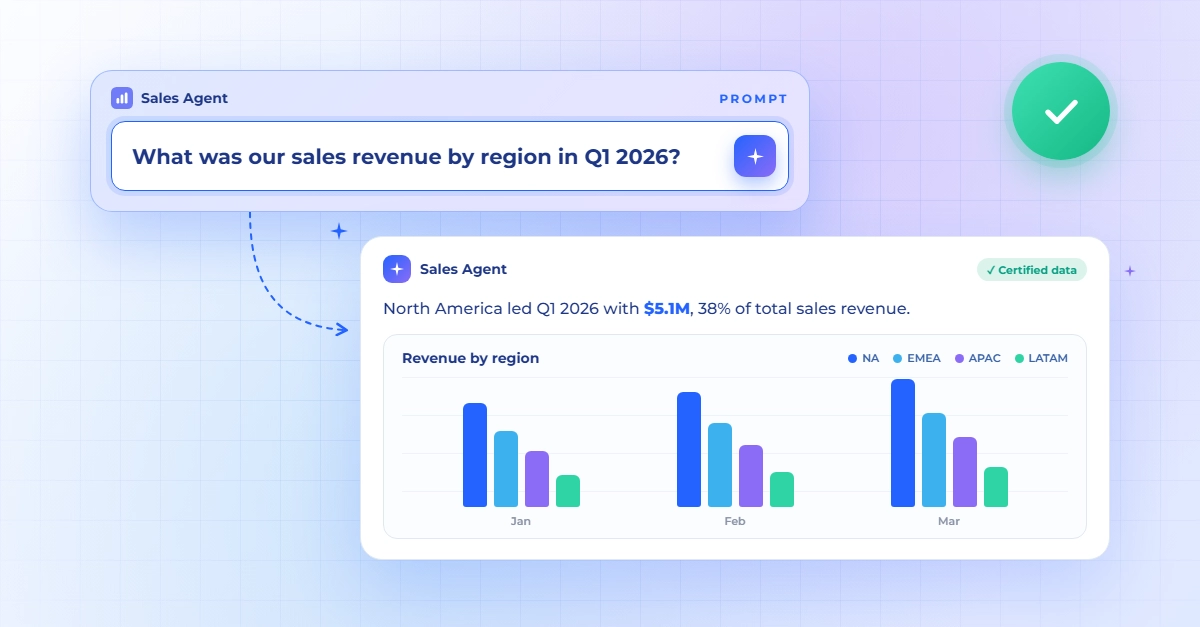
Agentic analytics is now automating BI: dashboards, charts, and reports are now generated by AI, but it can’t own the semantic layers, consistent metrics, and governance that make analytics trustworthy. This article explains where the value in BI is moving and how certifying analytics before it reaches users keeps AI-generated content trusted.
AI is changing how analytics gets built, because business users can now ask a question in natural language and get a chart, a summary, or a recommendation in seconds, without opening a dashboard. For BI teams and analysts, this raises two questions: if AI can provide an answer through a conversational interface, does BI still have business value? And when anyone can produce BI assets, what is the role of BI teams and data analysts?
This article looks at what agentic analytics automates in BI, what it can’t, and why trust becomes the real work of BI & analytics teams.
Automation Of The Front End
The most visible parts of BI are the easiest for AI to take over. Dashboards, reports, charts, and routine code all follow repeatable patterns, and AI handles patterns well. A tool that can read a table and describe it in natural language no longer needs someone to drag fields onto a visualization.
The figures point the same way. Gartner predicts that by 2027, 90% of today’s content consumers will become content creators, enabled by AI. It also predicts that by 2028, 60% of existing dashboards will be replaced by generated narratives and visuals. The result is a lot more analytics, written by a lot more people, many of whom don’t need to think about how a metric is defined or where its data comes from.
However, more content doesn’t mean more trust or higher quality, because when anyone can generate an answer, the volume of BI content grows faster than any team can review it, and the gap between what is produced and what is verified keeps getting bigger.
That doesn’t mean the job of those building assets is obsolete, because many features sold as agentic are still single-step assistants: they answer a question but don’t run a process on their own. AI output also isn’t deterministic. The same question can return different answers, and an answer can look polished and still be wrong. In workflows with several steps, each step can inherit and compound the previous one’s errors.
The adoption data shows how far there is to go. In a 2026 Gartner survey, only 8% of data and analytics leaders reported full AI integration across the data-to-insight workflow. Gartner also estimates that the visual layer, the part most exposed to automation, makes up only about 25% of a BI developer’s job. The remaining 75% is where the work moves: defining what the data means, keeping metrics consistent, and checking that outputs can be trusted. The same shift can apply to analytics engineers, BI admins, and the leaders who run them.
Where The Value Moves and What AI Can’t Own Alone
Now it’s easy to generate a chart, dashboard, or report with AI, but the hardest part is everything that this depends on. For example:
1. Semantic layers
An AI agent can write a query, but it can’t know that “customer” means something different in sales and in finance, or which table holds the approved revenue figure. That context lives in the semantic layer: the definitions, metrics, and relationships that translate raw data into business terms. Without a consistent one, agents fill the gaps with guesses, and then present them as confident answers. Gartner predicts that by 2028, 60% of agentic analytics projects relying solely on MCP will fail for lack of a consistent semantic layer.
2. Metric drift
Most organizations already have the same KPI calculated with different formulas in different tools. A human analyst may eventually notice the mismatch, but an AI agent will simply pick one version and present it confidently. As more people generate BI content, every inconsistency in the underlying definitions gets repeated at a larger scale.
3. Governance gaps
Access rules are often defined at the semantic model level, which only protects data that is reached through that model. Agents can take a different path. In Microsoft Fabric, for example, rules defined in a semantic model don’t apply if an agent or user reads the underlying lakehouse directly, for instance through a notebook, unless security is also enforced at the storage layer. It’s worth checking how your environment is configured before agents get broad access.
These problems are only solved by people who understand the business meaning of the data and the controls around it, which is what BI & analytics teams already have.
What You Can Put In Place
A software engineering team knows very well not to push code to production without testing; they keep it under version control, build and test it in separate environments, and release it only when it passes agreed checks. BI & Analytics can (has to?) work the same way:
- Version control for dashboards, semantic models and metric definitions, so every change is traceable and reversible.
- Separate development, test and production environments, so experiments stay out of the reports the business relies on.
- Automated validation against acceptance criteria written in business terms, such as “revenue by region must match the finance-approved figure.”
- Guardrails that block anything failing those checks, so a bad result is caught before a decision depends on it.
- Agent output validation, where AI answers are verified against referenced business questions, and monitoring them once they’re live.
This is the logic behind continuous certification, and it’s what Wiiisdom continuous certification for Power BI and Tableau, and now Fabric, does: validate analytics automatically before it impacts users. When anyone can create content, certification ensures that what reaches the business has been validated.
From Building Analytics to Certifying It
As agentic analytics spreads across BI, AI will keep taking over the work of producing dashboards, charts, and summaries. What it can’t take over is the work of making sure those outputs are correct, trustworthy, and safe to act on. It can’t be judge and jury. As more people become creators, that work becomes more valuable, not less. For BI & analytics teams, the shift is from building analytics to ensuring its reliability: owning the definitions, the controls, and the checks that make AI-generated content trustworthy. AI makes everyone a creator, but you need to ensure what they create is trusted.
If you want to learn more about our continuous certification capability, get in touch today.