Wiiisdom for regulatory compliance
Who can prove the data behind the decision was right?
When a regulator questions a reported figure, someone has to show it was accurate, certified, and traceable. At the analytics layer, most organizations can’t.
Regulated organizations are accountable for the figures their dashboards and reports produce, not only the data underneath them. Wiiisdom validates those figures against the source, certifies them, tracks every change, and keeps the evidence audit-ready, all the way to the point of decision.
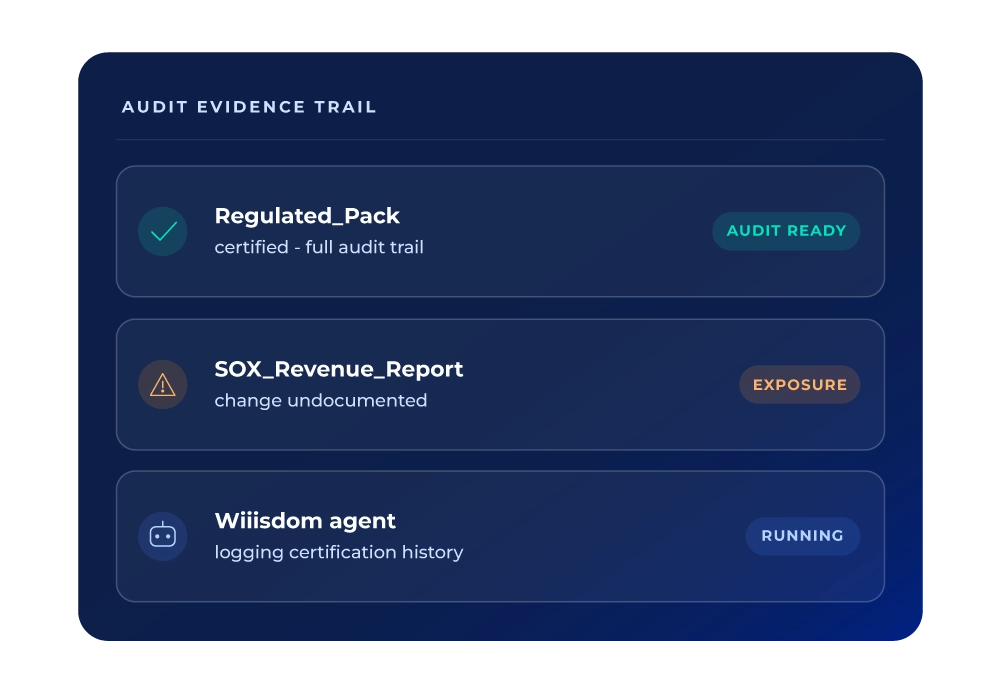
The analytics governance platform for the world’s most data-critical enterprises.
Why it matters
The proof has to exist before the auditor asks.
Every framework that touches reporting requires the same thing: prove that what decision makers saw was accurate and that any change was documented. That requirement does not stop at the data layer. It extends to the dashboards and KPI calculations between the data and the decision.
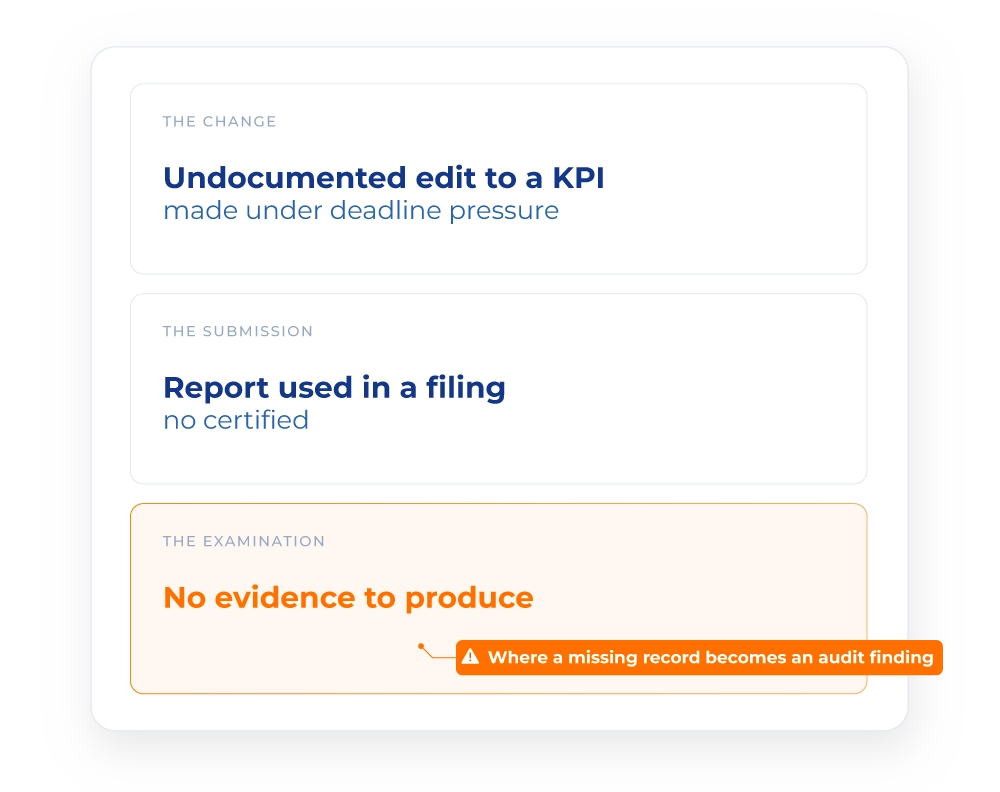
Manual processes do not produce reliable evidence. No regular checks were run, the change was undocumented, the report broke weeks after the submission. A modern, data-driven organization cannot afford to spend hours digging through logs after the fact, reconstructing proof under examination pressure instead of looking up a record that was already there.
Where the exposure sits
Evidence gaps
Without regular checks and with undocumented changes, there is nothing to show an auditor.
Reporting risk
A figure can be wrong for weeks before anyone outside the team notices.
Reconstructed proof
Assembling evidence after the fact takes longer, and holds up worse, than evidence that already existed.
What it does
Make analytics compliance measurable, not manual.
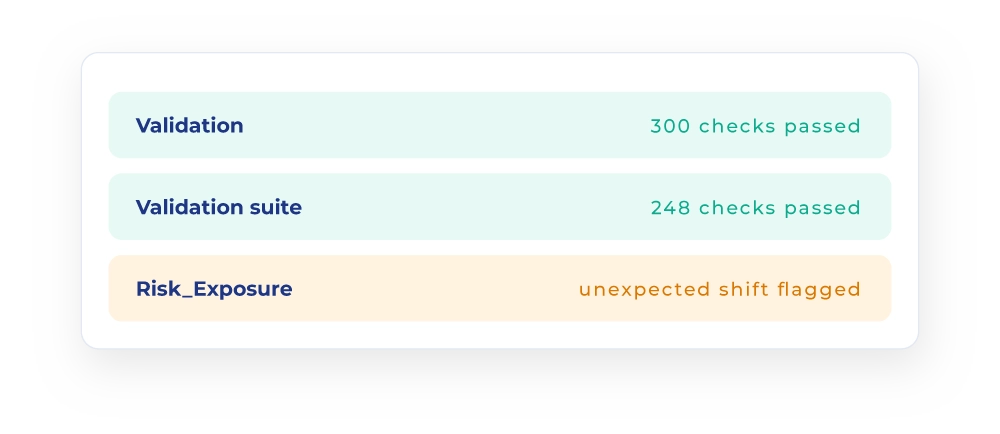
Regulated companies must guarantee that reported figures, financials, risk metrics, regulatory reports, are accurate and reproducible. Wiiisdom helps by detecting data discrepancies between source systems and BI reports (Power BI, Tableau), automating data validation tests across dashboards and datasets, and monitoring unexpected changes in KPIs over time.
- Detects data discrepancies between source systems and BI reports.
- Automates data validation tests across dashboards and datasets.
- Monitors unexpected changes in KPIs over time.
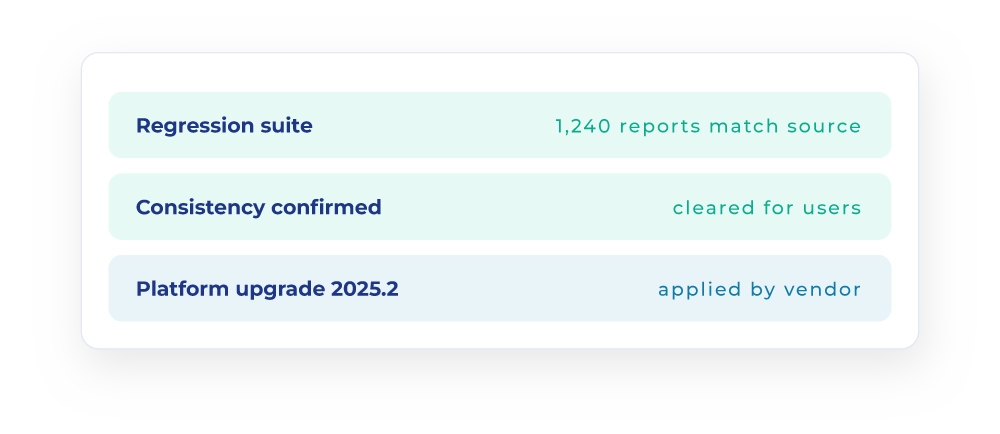
When upgrades or patches are applied by BI vendors on Cloud BI systems, regulated organizations need to revalidate their environment and ensure consistency. Wiiisdom re-runs validation across the environment after every upgrade and confirms reports stay consistent, before users or auditors find a discrepancy.
- Revalidates the environment after every vendor upgrade or patch.
- Confirms consistency of reports and KPIs post-upgrade.
- Surfaces discrepancies before users or auditors do.
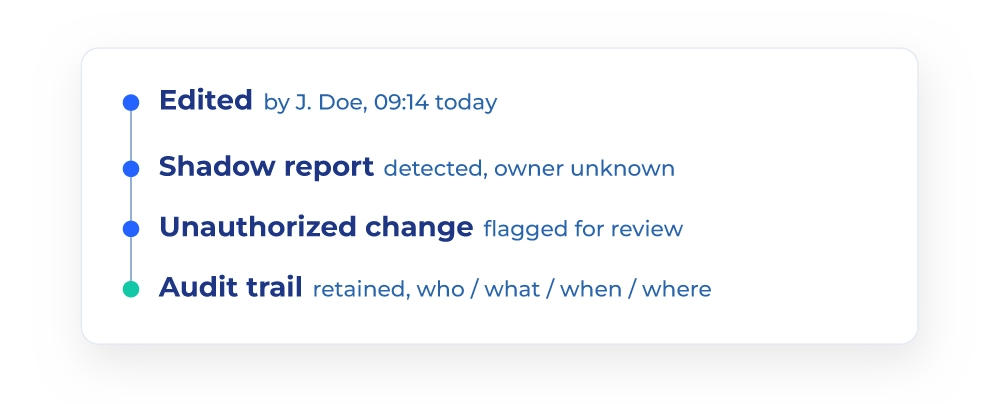
Compliance requires strict control over who can publish, modify, and access analytics content. Wiiisdom provides audit trails of report changes (who changed what, when, and where), visibility into unused, duplicated, or shadow reports, and detection of unauthorized modifications in dashboards.
- Audit trails of report changes: who changed what, when, and where.
- Visibility into unused, duplicated, or shadow reports.
- Detection of unauthorized modifications in dashboards.
Result: you can demonstrate governance over your BI layer during audits, instead of having a "black box" of uncontrolled reports.
The payoff
From reconstructing proof to audit-ready by default.
Compliance at the analytics layer is usually a scramble after the fact. Governed continuously, the evidence is already there, and the figures hold up before anyone asks.
- Evidence reconstructed by hand, digging through logs after the fact
- No regular checks, so a wrong figure surfaces only when it is questioned
- Shadow and duplicate reports nobody controls or can account for
- The same KPI carries different values across reports
- A vendor upgrade breaks reports silently, found weeks later
- Audit-ready evidence already captured, no log-digging required
- Automated validation across dashboards and datasets, on a schedule
- A full audit trail: who changed what, when, and where
- One enforced definition per metric, conflicts surfaced and reconciled
- Every vendor upgrade revalidated before it reaches production
Frameworks it supports
One governance layer across the regimes you answer to.
Wiiisdom’s certification, audit trail, and monitoring capabilities are not framework-specific. They support the evidence each of these requires at the analytics layer.
01
SOX
Demonstrable controls and a documented path to production for every change to financial reporting.
02
GxP
Platform validation and upgrade validation for pharma and life sciences, with traceable evidence.
03
GDPR & CCPA
Accuracy and accountability obligations across the EU, UK, and California.
04
BCBS-239
Accuracy, completeness, and traceability of risk data aggregation and reporting for banks.
Customer story
“In a validated environment, you need to stand up your tests once and set a frequency to test as often as you want, so that when changes come down the pike, you are not scrambling for another testing team and reloading documentation. You can stay on top of it.”
Senior Manager, R&D Business Technology, Pfizer