What is Agentic Analytics Governance?
Agentic Analytics Governance is the application of intelligent, autonomous agents to the governance of BI and analytics environments. Governance agents run continuously: they watch dashboards, KPIs, reports, and semantic models, detect anomalies before they reach users, recommend remediation in context, and act within autonomy boundaries the enterprise defines. Agentic Analytics Governance replaces periodic, manual governance with governance that operates at machine speed and enterprise scale.
Category: Analytics Governance, a category recognized in the Gartner® Hype Cycle™ for Data and Analytics Governance.
Operates on: Dashboards, reports, KPIs, semantic models, and AI-generated analytics across BI platforms such as Tableau, Power BI, and SAP BusinessObjects.
Replaces: Periodic, manual, ticket-driven governance checks and reactive firefighting.
Pioneered by: Wiiisdom, the first Agentic Analytics Governance platform.
Related terms: Analytics Governance, Data Governance, AI Analytics Governance, agentic AI.
The analytics governance platform for the world’s most data-critical enterprises.
Why does Agentic Analytics Governance exist?
Agentic Analytics Governance exists because AI made analytics usage explode past what traditional analytics governance can control. Self-service BI already multiplied dashboards and reports faster than teams could validate them. AI Analytics multiplies the problem again: every employee can now ask infinite questions in natural language, content proliferates on the fly, and compute costs climb at the speed of adoption. Governing that environment by hand, even with good tooling, is no longer possible.
The risk is not theoretical. AI does not create trust in analytics. It exploits the context it is given, and it amplifies whatever inconsistencies that context contains.
Agentic Analytics Governance is the response: governance that changes in nature. Instead of humans running periodic checks, autonomous agents govern the analytics environment continuously, at the same speed and scale as the systems they oversee.
of data and analytics leaders with AI Analytics in production say they have already experienced inaccurate or misleading AI outputs.
Salesforce, State of Data and Analytics, Nov 2025, 3,800 decision-makers, 18 countries
Authority signals
Recognized category. Documented risk. Proven adoption .
Named in the Gartner® Hype Cycle™, three years running
Analytics Governance is a recognized category in the Gartner Hype Cycle for Data and Analytics Governance, which defines it as the framework by which organizations determine how decisions are made about analytic content. Wiiisdom is listed as a sample vendor in the Analytics Governance category in 2024, 2025, and 2026.Gartner, Hype Cycle for Data and Analytics Governance, 2026. GARTNER is a registered trademark and service mark of Gartner, Inc. and/or its affiliates in the U.S. and internationally, and HYPE CYCLE is a registered trademark of Gartner, Inc. and/or its affiliates and are used herein with permission. All rights reserved. Gartner does not endorse any vendor, product or service depicted in its research publications.
Learn more →The pioneers name trust as the obstacle
According to Salesforce's State of Data and Analytics report (November 2025, 3,800 respondents, 18 countries), 89% of data and analytics leaders with AI Analytics in production report having experienced inaccurate or misleading AI outputs. Anthropic, which automates 95% of its own internal analytics with its Claude models, states that the hard problem in AI analytics is neither the code nor the model, but context and verification.
600+ enterprises govern with Wiiisdom
More than 600 enterprises govern their analytics with Wiiisdom, including major financial institutions, global pharmaceutical companies, and government agencies, in environments ranging from hundreds to tens of thousands of dashboards.
Where it fits (The data journey)
Where does Agentic Analytics Governance fit in the governance stack?
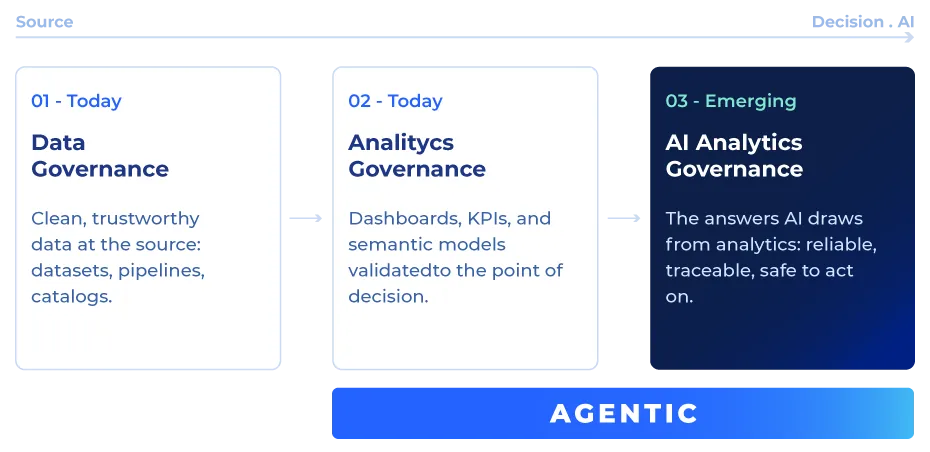
Analytics governance maturity climbs a ladder of three sequential layers, each depending on the one below it. Data Governance secures data at the source: quality, lineage, and access for datasets, pipelines, and catalogs. Analytics Governance secures what happens after: the dashboards, reports, KPIs, and semantic models where data becomes a decision. A perfectly governed dataset can still produce a wrong number on the screen a CFO is reading, because reports merge, filter, and reshape data. Analytics governance closes that gap, often called the last mile. AI Analytics Governance secures the AI layer itself: making sure the answers an AI agent or natural-language interface draws from analytics are reliable, traceable, and safe to act on.
Agentic Analytics Governance is not a fourth layer. It is the operating mode that makes the upper rungs achievable at scale. Analytics governance and AI analytics governance both require continuous validation across thousands of assets and infinite AI-generated answers. Only autonomous agents can execute governance at that volume and speed.
Disambiguation
Three terms that get confused. Three precise answers.
Agentic Analytics Governance vs Analytics Governance
Analytics Governance is the discipline of maintaining visibility and control over your BI environment: certified dashboards, tested accuracy, monitored data sources, enforced compliance. It tells you what's happening and where the risk is. But someone still has to notice the alert, investigate the cause, and decide what to do about it.
Agentic Analytics Governance takes that same discipline and puts agents to work on it. Instead of waiting for a person to review every anomaly or capacity warning, agents continuously observe, diagnose likely causes, and recommend or take action, all within human-approved guardrails. Governance stops being something your team has to keep up with manually and becomes something that scales on its own.
In short: governance is the discipline of knowing what's wrong. Agentic governance is what fixes it, at scale, without adding headcount.
Analytics Governance vs Data Governance
Data Governance manages data quality, lineage, and access at the source layer: datasets, pipelines, and catalogs. Analytics Governance operates downstream, at the consumption layer: the dashboards, KPIs, and AI answers where decisions are actually made. The two are complementary and sequential. Clean data at the source does not guarantee a correct number on a screen, because the first thing anyone does in a report is transform the data.
Agentic Analytics Governance vs AI Governance
AI Governance provides oversight, risk management, and policy enforcement for AI applications in general: models, agents, and their compliance posture. Agentic Analytics Governance is specific to the analytics domain: it uses agents to govern BI and analytics content, and it governs the analytics that AI systems consume and produce. The two intersect where AI meets analytics, but AI Governance does not validate whether a dashboard, KPI, or AI-generated insight is correct. Agentic Analytics Governance does.
From control to delegated trust
Our Four-Stage Governance Model
We don’t ask customers to choose between manual control and blind automation. Our platform meets teams where they are and grows with their confidence.
Visibility & Detect
Real-time clarity across Power BI and Tableau. No inference, no surprises, just the facts, so admins act with confidence.
Recommend
Agents add reasoning: what they observed, which policy applied, how confident they are, and what impact acting would have. Better decisions, faster: control stays with the admin.
Guarded Execution
Agents act autonomously, but only inside explicit, reversible, admin-defined policy envelopes. Routine work gets handled; exceptions still escalate to humans.
Delegated Judgment
Mature teams hand off entire classes of governance decisions, backed by full audit trails and human-owned policy at every step.
Glossary
Related terms, defined precisely.
Analytics Governance
Analytics Governance is the discipline of ensuring that BI content (dashboards, reports, KPIs, and semantic models) is accurate, certified, performant, and continuously monitored. It operates at the consumption layer of the data stack, the point where data becomes a decision.
AI Analytics
AI Analytics comprises any form of AI applied to analytics, including GenAI Analytics and Agentic Analytics. It includes the use of AI to query and analyze data in natural language, generate insights automatically, and act on analytics workflows. It appears both inside BI tools, such as Copilot in Power BI or agents in Tableau, and directly on data platforms, such as Genie in Databricks or Cortex in Snowflake.
AI Analytics Governance
AI Analytics Governance is the discipline of making the answers AI systems draw from analytics reliable, traceable, and safe to act on. It extends analytics governance to AI-generated insights, holding them to the same standards as traditional BI content.
Analytics Governance Agent
An analytics governance agent is an autonomous software component that continuously monitors an analytics environment, alerts on problems, recommends corrections in context, and takes bounded actions within autonomy limits the enterprise defines.
Human in the Loop
Human in the loop is the principle that a person retains control over sensitive or irreversible decisions in an automated system. In Agentic Analytics Governance, agents execute at machine speed while humans set policy and approve critical actions.
Continuous Certification
Continuous Certification is the ongoing validation of BI content against live data and business rules, with a visible trust signal that is automatically revoked the moment the content drifts from what was tested. This capability is patent-pending.
Lifecycle Management
Lifecycle Management is the enforcement of governance policies across the life of BI content: promotion guardrails, versioning, approval workflows, and rollback, preventing report proliferation and uncontrolled change.
Predictive Monitoring
Predictive Monitoring is the continuous observation of BI content and platform health to detect anomalies early, prevent outages, maintain performance, and keep compute costs under control.
Semantic Layer
A semantic layer is the layer that translates raw data into business terms: metrics, dimensions, and hierarchies. Both human users and AI agents depend on semantic models to interpret data consistently.
The Last Mile
The last mile of the data journey is the point where data becomes a decision: the dashboard, report, or AI answer a person acts on. It is the layer analytics governance secures and data governance cannot see.
BI FinOps
BI FinOps is the practice of making analytics costs visible and controllable at the asset level, across both the BI platform bill and the cloud warehouse compute beneath it.
MCP (Model Context Protocol)
MCP, the Model Context Protocol, is an open standard that lets AI systems interact with software platforms and their APIs through context rather than custom integration. In analytics governance, MCP lets AI assistants query and orchestrate governance operations across systems.