
Analytics Governance: The New Strategic Imperative for CDOs, CDAOs and Data Governance Leaders

Executive Summary
In an era defined by rapid technological advancement and the widespread rush to adopt Artificial Intelligence (AI) everywhere, traditional approaches to Data Governance are no longer sufficient. The rush to use GenAI in particular is driven by its ability to automate insight generation, accelerate decision-making, and democratize access to advanced analytics, transforming how organizations interact with data. As more individuals across organizations engage with data, the risk landscape expands, which demands a more robust global governance strategy.
At the heart of this transformation is the analytics layer, the point where data meets decision-making. Generative AI is amplifying the visibility of this layer, enabling faster, more intuitive access to insights, but also introducing new risks around trust, quality, and compliance. This shift makes it essential to govern not just the data itself, but how data analytics is produced, shared, and consumed across the enterprise. It’s not because the data is governed early on in the journey that it’s not wrong further on.
“Analytics Governance: The New Strategic Imperative for CDOs, CDAOs and Data Governance Leaders” makes a compelling case for why data leaders must lead the charge in redefining governance frameworks. The white paper introduces Analytics Governance as a critical evolution beyond traditional data governance, emphasizing its role in enabling responsible, scalable, trustworthy, and value-driven data analytics use. It demonstrates that Analytics Governance is more than traditional Data Governance; it complements it, extends it, and is applied at the consumption layer, because robust Data Governance alone doesn’t guarantee insight into how users actually use or misuse data afterwards.
This paper explores:
- Why this matters now: The urgency driven by AI adoption, data democratization, and alignment with corporate strategies around cost optimisation and the imperative to do more with less. It’s time to maximize data and analytics investments to unlock greater value, improve agility, and reduce inefficiencies.
- Why data governance is not enough: The limitations of traditional data governance frameworks in today’s analytics-rich environment.
- The strategic value of Analytics Governance: How it drives business outcomes, trust, and innovation.
- Key pillars of an Analytics Governance strategy: The foundational elements required for effective implementation.
- How to measure Analytics Governance: Practical metrics and KPIs to assess maturity and impact.
- A call to action for data leaders: You must now actively own the Analytics layer and ensure governance until the last mile of the data journey.
- How to get started: Data leaders don’t need to start from scratch. Implement a Blueprint framework to start the Analytics Governance journey.
As organizations strive to harness the full potential of data analytics and AI, Analytics Governance must become a cornerstone of enterprise strategy. This white paper provides the insights and frameworks needed to help data leaders take decisive action and embed an Analytics Governance strategy into their global data governance agenda.
Introduction
The data landscape is evolving at an unprecedented rate. As organizations race to harness the power of data, analytics has become the driving force of enterprise decision-making. Yet, amid this surge in analytical capability, a critical gap remains: most organizations lack governance over the final layer of analytics—the dashboards, reports, and AI-generated insights that directly inform business decisions.
Research on The State of Analytics Governance 2025 revealed that maturity in Analytics Governance is lower than perceived, with few organizations implementing strategies such as continuous validation, certification, and monitoring of analytical assets, as they do, however, with raw data.
While many organizations have invested heavily in managing data quality, lineage, and access, fewer have extended these principles to the dashboards, reports, and insights that shape high-stakes decisions. This oversight leaves organizations vulnerable to inconsistent metrics and misaligned strategies, because between the raw data and your BI content, there can be many transformations leading to problems in the consumption layer. It also fuels the rise of Shadow BI, where business teams create and rely on ungoverned analytics assets outside official oversight, ultimately leading to poor decision-making.
This white paper makes the case for Analytics Governance as the next critical frontier for data leadership. It argues that traditional Data Governance is no longer sufficient in a world where analytics is dynamic, decentralized, and deeply embedded in business processes. We explore why CDOs, CDAOs, and Data Governance leaders must lead the charge in extending governance to the BI/Analytics layers.
The Leadership Mandate: Why This Matters Now
The rise of self-service analytics, GenAI Analytics, and decentralized data usage has outpaced traditional governance models. Business users now build dashboards, generate insights, and make decisions, often without centralized oversight. While this democratization of data has unlocked agility and innovation, it has also outpaced the reach of traditional governance models.
Historically, Analytics Governance has been treated as an extension of data governance, heavily focused on data quality, and that’s OK—garbage in, garbage out. However, in today’s environment, this is no longer enough. Data leaders are also accountable for the trustworthiness of insights; the last mile of the data journey.
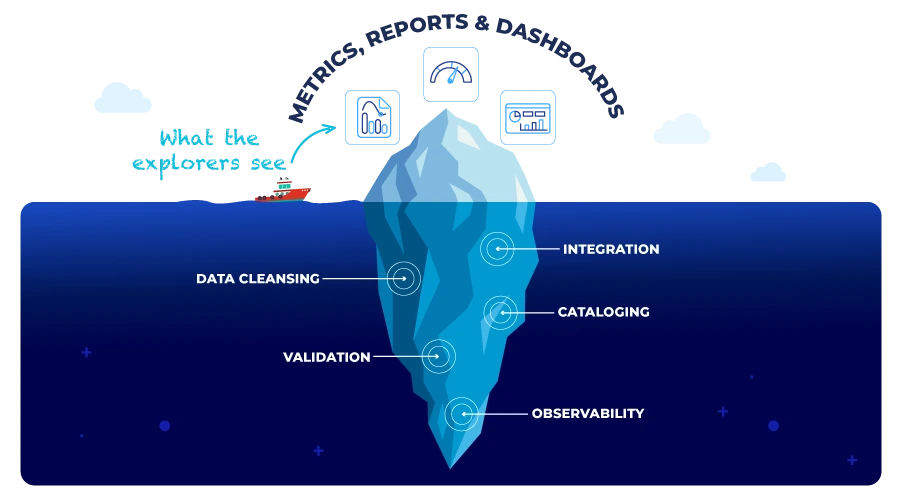
Think of data like an iceberg: The hidden mass below the surface is where data goes through cleansing, validation, integration, cataloging, observability, etc. It’s the foundation of the iceberg and critical for data leaders. However, focusing too much on the foundation and forgetting the last mile of the data journey, the BI & Analytics, is like forgetting that what explorers see is actually the tip of the iceberg. Data leaders often fall into “The Foundation Trap”—spending years meticulously building a robust data infrastructure beneath the surface. While essential, this hidden mass of work can go unnoticed if it doesn’t translate into visible business value. At the same time, “The Near Miss” reminds us that even a single error in a dashboard—the visible tip of the iceberg—can undermine years of foundational effort. Stakeholders rarely see the data pipelines, governance frameworks, or quality controls; they see the output, and if that output fails, trust in the entire data strategy can collapse in seconds.
To avoid these pitfalls, implementing an Analytics Governance strategy can no longer be seen as optional, but instead, a leadership responsibility. Gartner states, “With growing regulation tied to AI, analytics governance is now required, not a nice-to-have.”1 Furthermore, the scope of responsibility among data leaders doesn’t stay at insights. With the rise of decision intelligence and automation, data leaders are now the goalkeepers of enterprise reliability. When everything runs smoothly, their work is invisible, but when something fails, the responsibility lands squarely on their shoulders.
Building on this, the average tenure of a CDO remains short, often due to a combination of factors such as unclear mandates, a lack of visible impact, and the time it takes to demonstrate tangible value. One way to help address this challenge is by accelerating time to value, and this is where Analytics Governance plays a meaningful role. When done right, it enables data to deliver value, it builds organizational trust, and ensures that data can truly shine—across every use case, not just data analytics. It is also very aligned with corporate strategies: doing more with less and embracing AI as a catalyst for smarter, more efficient decision-making.
With the leadership case established, we now need a clear and shared definition. What exactly is Analytics Governance, and how does it extend traditional Data Governance at the decision layer?
1Source: Gartner, Hype Cycle for Data and Analytics Governance 2024, Guido De Simoni, Andrew White, 18 June 2025. GARTNER is a registered trademark and service mark of Gartner, Inc. and/or its affiliates in the U.S. and internationally and HYPE CYCLE is a registered trademark of Gartner, Inc. and/or its affiliates and are used herein with permission. All rights reserved.
What Is Analytics Governance?
Analytics Governance is an umbrella term referring to different methodologies and sub-categories to ensure trust, consistency, accountability, and compliance in analytics outputs. Research confirms this understanding of the term, with respondents associating Analytics Governance with a diverse range of areas:

When you see the term “Analytics Governance”, what does it mean to you? The State of Analytics Governance 2025 Report.
In contrast with traditional data governance, which just focuses on the data underneath, Analytics Governance covers dashboards, KPIs, models, and insights. It empowers data leaders to scale analytics responsibly across their enterprise.
Now that we’ve defined Analytics Governance, the next question is why Data Governance alone, even when strong, isn’t sufficient. The following section examines where traditional Data Governance stops and why the final step in the data journey needs explicit governance.
Why Data Governance Alone Isn’t Enough Anymore
Data governance focuses on ensuring the integrity and quality of (raw) data. It’s foundational, but it stops short of governing what truly drives business decisions: analytics outputs like dashboards, KPIs, and GenAI insights. Even if you have a good foundational data governance strategy, you can’t control how everyone is going to use (or misuse) data. These outputs are often at risk of being duplicated, misinterpreted, unrefreshed, incomplete, inaccurate, or simply left uncontrolled, creating a dangerous illusion of trustworthiness. According to research, 77% of respondents encounter issues or inaccurate BI content that is already in production at least once or more per month. This leads to less trust and lower adoption, highlighting that, despite traditional governance, without Analytics Governance, even the cleanest data can lead to flawed insights and poor decisions.
Consider a scenario where a dashboard pulls from a trusted data source, but applies outdated logic or inconsistent filters. The result? Misleading KPIs that drive the wrong decision.
Unfortunately, most data governance initiatives fail because they focus too much on control and not enough on value delivery. They overlook the “last mile” where data becomes insight, and insight becomes action. This is where Analytics Governance steps in: to ensure that what’s visible, interpretable, and actionable is also reliable, consistent, accessible, and aligned with business goals. Governance must evolve: Data and Analytics Governance are complementary and must be implemented together.
Recognizing the governance gap is only half the equation. The real prize is business value: lower costs, higher trust and adoption, and faster decisions aligned to ‘do more with less.’ The next section quantifies the strategic value of implementing Analytics Governance.
The Strategic Value of Analytics Governance
A well-implemented Analytics Governance strategy delivers considerable benefits to organizations:
- Delivers cost savings by streamlining infrastructure, reducing computing expenses, and improving operational efficiency.
- Builds trust in analytics across business units.
- Drives adoption by providing accurate and trusted information across the business.
- Accelerates decision-making by eliminating confusion and duplication.
- Reduces risk from regulatory exposure, model bias, and inconsistent reporting.
- Reduces cost by increasing the efficiency of development teams seeking higher quality and performance.
- Elevates the role of the CDAO/CDO as a business enabler and innovator, not just a data custodian. Analytics is on the front end of an organization’s data that everyone sees, whether they are data people or not. Without trustworthy BI and reporting, nothing else they do or plan to invest in will have credibility or support. This reiterates the strategic importance of Analytics Governance in building trust, driving adoption, and unlocking the full value of data investments.
To realize these outcomes systematically, organizations need a practical architecture. The next section introduces the core pillars that operationalize Analytics Governance at scale.
The Key Pillars of Analytics Governance
Analytics Governance refers to different methodologies and sub-categories, but stands on 6 key pillars:
1. Metric & KPI Standardization
This is essential for ensuring clarity and alignment across the organization. By defining and centrally managing business-critical metrics, organizations can maintain consistency across dashboards, reports, and teams. Embedding these standardized definitions directly into analytics tools helps prevent metric drift and misalignment, enabling more reliable and trusted decision-making at every level.
2. Asset Lifecycle Management
Asset Lifecycle Management provides governance of the creation, revision, approval, and retirement of dashboards and reports, enabling organizations to create a trustworthy BI & Analytics environment. If you can retire and/or deduplicate reports more effectively, this will help deliver a clear return on investment by streamlining maintenance, reducing the cost of unnecessary content, and maintaining a healthy and performant environment. Assigning ownership and accountability also ensures that dashboards remain relevant and accurate, while introducing quality assurance checkpoints, such as peer reviews or automated validation, helps catch errors before they impact business decisions.
3. Access & Usage Controls
Although it’s a big part of traditional data governance processes, access and usage controls in the consumption layer are essential too. It protects sensitive analytics content and ensures responsible use. By implementing role-based access controls, organizations can ensure that users only see the insights relevant to their roles, minimizing any risk of data leakage or misinterpretation. It also helps identify underused assets, flag potential misuse, and anticipate issues before they escalate. This not only strengthens security and compliance within your BI & Analytics platform but also improves the efficiency and effectiveness of the analytics ecosystem.
4. Analytics Stewardship
Analytics stewardship plays an important role in successfully implementing Analytics Governance. Empowering business-aligned stewards to oversee the quality and adoption of analytics will not only help ensure insights are trusted and actionable but also foster collaboration between data, analytics, and business teams. These stewards act as connectors and help promote a culture of accountability and continuous improvement, where analytics is not only well-managed but also deeply embedded in everyday decision-making.
5. Automated and Dynamic Certification
Automated and dynamic certification is essential for building trust in analytics at scale. By ensuring that users can rely on the accuracy and reliability of the data they consume, organizations foster confidence in decision-making and insight generation, particularly for mission-critical or sensitive assets. This is especially critical in the era of AI-generated analytics, where governing the underlying data is key to unlocking the full potential of AI-driven insights. Dynamic certification processes also help mitigate reputational, financial, and regulatory risks by automatically decertifying outdated or incorrect assets, ensuring that only high-quality, recent content remains in use.
6. Platform Monitoring
Platform Monitoring refers to the continuous oversight of a BI & Analytics platform to ensure that the whole environment is cost-efficient, performing as expected, remains compliant, and is being used responsibly. It provides real-time visibility into how data analytics assets are being used, helps detect anomalies in performance, broken dashboards, or unauthorized access, and allows for proactivity so issues can be resolved quickly before they impact decision-making. BI & Analytics platforms have made platform monitoring increasingly tied to financial outcomes; capacity strain and inefficient content don’t just affect performance; they drive up costs. Our ebook Be FinOps-Ready for BI and Analytics explores this connection in depth.
Measures of Success of Analytics Governance
To ensure an Analytics Governance strategy delivers tangible value, it’s essential to define clear measures of success. Here is a non-exhaustive list of how it can be measured:
- Lower Computing Costs: Streamline infrastructure by consolidating analytics platforms and eliminating redundant assets, reducing overhead and computing expenses (for example, Power BI capacity costs or cloud hosting costs).
Optimized Operational Efficiency: Standardize metrics and automate reporting to reduce manual effort and accelerate insights delivery. - Unlocked AI Potential: Enhance data quality to ensure GenAI insights’ reliability, eliminate distrust, and boost user adoption.
Minimized Risks and Comply with Regulations: Enforce robust Analytics Governance to reduce errors and ensure compliance, safeguarding your organization. - Scaled Analytics: Enable scaled analytics by promoting data literacy and user empowerment. Equip teams to confidently interpret and apply insights, driving informed decisions, fostering a data-driven culture, increasing adoption, and maximizing the value of analytics across the business.
- Reduced Costs and Increased Value: Optimize data management processes to lower costs and maximize the return on your investment.
- Strengthened Data Governance Strategy: Don’t jeopardize years of investment; the analytics layer is the visible tip of the iceberg. Ensure you implement Data and Analytics Governance together.
A Call to Action for Data Leaders
Data leaders can no longer ignore the call for Analytics Governance. Data Analytics is central to decision-making, and data leaders must now actively own the analytics layer, not leave it to chance or Shadow BI and wasted investments. The risks of inaction are real: regulatory fines, strategic missteps from inaccurate insights, erosion of trust, and uncontrollable chaos that takes forever to fix, leading to debt. This is existential for data leaders because even if bad data is the result of rogue actors, the fault will remain with them.
To lead effectively, CDOs, CDAOs, and Data Governance leaders must integrate Analytics Governance into their core data strategy, champion a culture of insight accountability, and deliver visible, high-impact wins that demonstrate the value of governance where it matters most. This is your moment to let your data governance truly shine.
To move from conviction to capability, you need a blueprint you can start applying immediately. The next section provides a practical, step‑by‑step path that builds on your existing Data Governance investments.
Implement a Blueprint for Analytics Governance
Implementing Analytics Governance doesn’t require starting from scratch; it requires strategic alignment, smart use of existing assets, and the right solutions. To understand how well Analytics Governance is implemented within your organization, it’s advised to have a Blueprint implementation. Here are the key steps to carry out:
1. Start with a maturity assessment
Begin by evaluating your current governance capabilities. This helps identify strengths, uncover gaps, and prioritize areas for improvement, providing a clear baseline to measure progress and align stakeholders around a shared vision.
2. Align stakeholders across the organization
Analytics Governance isn’t a siloed effort. Stakeholders across data, analytics, and business teams need to be aligned to drive adoption and embed governance into everyday workflows.
3. Leverage existing governance infrastructure
Most organizations already have some form of data governance in place. This might include:
- A data catalog or metadata management system
- Data stewardship roles or governance councils
- Policies and processes for data quality, access control, and compliance
- Tools for lineage, classification, and audit logging
These components are not wasted—they can serve as a foundation for Analytics Governance. For example:
- Use the same stewardship model to assign who owns dashboards and KPIs.
- Extend existing data catalogs to include analytics assets like reports, dashboards, and metrics.
- Build on existing access control frameworks to manage permissions in analytics platforms.
What’s important to note is that Analytics Governance should be integrated into the broader governance system—don’t create parallel governance structures. This will confuse stakeholders, require separate tools, increase operational overhead, and lower adoption. The goal is to extend rather than duplicate to accelerate adoption, reduce friction between teams, and create a unified governance experience for the whole data journey.
4. Choose enabling technologies
Scaling Analytics Governance requires enabling technologies that support visibility, control, and collaboration. Organizations should prioritize platforms that offer visibility through traceability and audit trails, control via enforceable rules and policies, and collaboration through features like dashboard and data source certification. These capabilities not only ensure trust and accountability but also foster alignment across data, analytics, and business teams.
Solutions like Wiiisdom are purpose-built for this mission—empowering organizations to deliver trusted and certified data analytics at scale. Wiiisdom was named as a sample vendor for the 2nd year running in the Gartner Hype Cycle for Data and Analytics Governance 2025, underscoring its commitment to innovation and excellence in this category.
The Future of Data Leadership
The role of data leaders is quickly evolving. As Data, Analytics, and AI Governance converge, the responsibilities of CDOs, CDAOS, and Data Governance leaders must now expand beyond data management.
With innovations such as GenAI Analytics, the risk potential has never been greater. With regulatory scrutiny also increasing, frameworks such as GxP (Good x Practices) demand proactive oversight, traceability, and accountability across the entire data journey.
Conclusion
Analytics Governance doesn’t replace Data Governance; it extends it to the decision layer, where trust, compliance, and value are ultimately won or lost.
The need for Analytics Governance has never been more urgent or more strategic. While organizations have made significant strides in managing data quality and access, the governance of analytics assets is a critical blind spot. Without governance of dashboards, KPIs, and GenAI insights, even the most robust data foundations can lead to misaligned strategies, inconsistent insights, and poor decision-making. CDOs, CDAOs, and Data Governance leaders must now take ownership of the analytics layer, integrate governance throughout the whole data journey, and be able to deliver trusted data analytics at scale.