
BI Path to Production: Operationalizing Trusted Analytics in Financial Services

Executive Summary
Large financial institutions face a growing tension: analytics must move fast enough to support decision-making across operations, finance, risk, regulatory, and executive leadership, while remaining controlled enough to withstand audit, compliance, and governance scrutiny. In practice, many organizations still rely on lifecycle models that define environments, but fail to operationalize the decisions, evidence, role separation, and production discipline required to trust analytics at scale.
The regulatory context makes this urgent. In financial services, SR 11-7 defines the expectations for model risk management that analytics feeding risk decisions must meet. SOX Sections 302 and 404 require executives to certify the integrity of financial reporting controls, which includes the analytics that feed them. DFAST and CCAR stress testing exercises place direct scrutiny on the data aggregation and reporting pipelines supporting capital calculations. BCBS 239 imposes accuracy, completeness, and reconciliation requirements on risk data aggregation across G-SIBs. OCC and FFIEC examination frameworks extend these expectations to operational and compliance reporting. SOC 1 attestation requirements extend this scrutiny to service providers, requiring evidence that controls over financial reporting data operate effectively across the full reporting period. Across all these frameworks, the common thread is the same: analytics that influence regulated outputs must be traceable, validated, owned, and controlled throughout their lifecycle, not just at the point of creation.
Defining governance policies for BI assets is relatively straightforward. Implementing and enforcing them at scale is not. Over years of working with the largest financial institutions, their regulators, and regulated enterprise BI teams, four structural weaknesses repeatedly emerge. First, stages and promotions are often blended together, making accountability unclear and promotion decisions difficult to audit. Second, risk tiering and regulatory classification often happen too late, after work has already progressed under the wrong control assumptions. Third, self-service BI paths frequently break segregation of duties by allowing the same person to build content and retain practical influence over production deployment. Fourth, production is too often treated as the end of the lifecycle, when it is in fact the beginning of the most consequential phase: the point at which drift, ownership gaps, performance issues, and stale content begin to accumulate.
This white paper proposes a more operational BI path to production model: three lifecycle stages (DEV, UAT, and PROD) separated by two explicit, auditable transitions. Each stage has defined objectives, personas, activities, and constraints. Each transition has named entry criteria, accountable approvers, traceable Go/No-Go decisions, and controlled promotion mechanics. Production is treated not as a final destination but as an actively governed state requiring monitoring, tiered certification, ownership reconciliation, policy enforcement, and structured retirement.
As AI tools generate narratives, anomaly alerts, and insight summaries at machine speed inside BI platforms and directly from data layers, the governance imperative is the same: every output consumed by a business user or executive needs an owner, a validation status, and an accountability trail, regardless of whether a human or an algorithm produced it.
For enterprise BI leaders, this is not only a governance model. It is an operating model for trusted analytics at scale. Done well, it reduces uncontrolled production change, strengthens audit readiness, ensures compliance with regulatory and internal control requirements, clarifies ownership, improves trust in critical analytics, and helps contain the hidden cost of large BI estates by identifying dormant, drifting, redundant, or ownerless content before those assets become operational liabilities. This is especially important in large financial institutions and other regulated industries, where the scale of self-service analytics has outgrown the effectiveness of manual governance alone.
But the case for operational governance extends beyond regulated industries. Any large enterprise running self-service analytics at scale faces the same compounding risks: ungoverned production estates, unclear ownership, redundant content, and analytics that drift from the decisions they are meant to support. Governance done well is not a compliance burden. It is a strategic advantage. It reduces operational costs, aligns analytics investment with corporate priorities, and builds the organizational trust required to act on data with confidence. For any enterprise where analytics has become infrastructure, making the governed path the scalable path is not just good practice. It is a competitive imperative.
The goal is not to add friction or ceremony. The goal is to make the governed path the scalable path through explicit lifecycle structure, continuous evidence, production observability, and practical enforcement mechanisms. In regulated environments, trust in analytics cannot depend on one-time validation or policy documentation alone. It must be operationalized. And in every large enterprise, the cost of ungoverned analytics is no longer theoretical. It is accumulating quietly, one unreviewed dashboard at a time. With agentic analytics now generating content at machine speed, that accumulation is about to become exponential. The organizations that govern their analytics outputs today will be the ones that remain in control tomorrow.
Common Patterns in Lifecycle Management: What Works and Where Gaps Emerge
Over the years, here at Wiiisdom we’ve seen what works and areas that need improvement when working with organizations on their lifecycle management frameworks. These challenges are amplified by the very nature of self-service BI platforms like Power BI and Tableau: by design, they democratize access and publishing, which is their greatest strength and their most significant governance liability. For organizations still running SAP BusinessObjects, the same structural gaps apply, often with less native tooling to address them. Large BI estates on SAP BusinessObjects frequently carry years of accumulated reports, orphaned universes, and undocumented business logic with no retirement history and no ownership trail.
The lifecycle principles in this paper apply equally, and in many cases the remediation need is more urgent. Well-intentioned BI path-to-production/SDLC frameworks often share common strengths: tier-based validation paths that differentiate treatment by risk level, named personas with defined responsibilities, explicit user acceptance testing activities, and approval gates before promotion to production. However, we have also seen several structural patterns that consistently introduce risk, audit exposure, or unnecessary friction for organizations. Below is a list of these so you can avoid them when building your framework:
1. Stages and transitions are merged
The act of promoting content (moving it from DEV to UAT, or from UAT to PROD) is the most important control point in the lifecycle. Yet it is frequently embedded inside the stage diagrams rather than treated as a distinct, auditable event. This means the entry criteria for each stage are ambiguous, the decision record is unclear, and the roles responsible for the transition steps are not formally named. Separating stages from transitions resolves this immediately. Transitions carry the entry criteria, the approval decision, the promotion act, and the audit trail. Stages carry the work.
2. Classification happens too late
Risk tier and regulated-content classification are frequently determined mid-development or at the point of the promotion request. By that point, days or weeks of work have already been carried out under the wrong governance assumptions. Many organizations formally classify Tableau and Power BI content as End User Computing (EUC), recognizing that business-built analytics outside formal IT controls require explicit risk assessment when they feed regulatory outputs. Whatever the regulation, the principle is the same: content that feeds regulatory outputs must be identified as early as possible, because it materially changes the controls applied throughout the rest of the journey.
Classification also belongs at the very beginning, before development begins. The tier drives the rigor of everything downstream. A dashboard used by three executives for regulatory-filing decisions carries far higher risk than an operational report used by ten thousand people. Classification rules should incorporate regulatory factors: PII exposure, sensitive data handling, C-level consumption, and dependence on externally reported outputs.
3. Segregation of duties in self-service paths
Self-service and citizen developer paths frequently allow the same individual who built the content to promote it to production. Under a regulatory lens, this is a clear Segregation of Duties deficiency. The developer of a production artefact should never also be the person who deploys it; a requirement well established in banking IT governance frameworks.
The recommended pattern is automated promotion via a service principal, with human involvement limited to the approval decision. No individual should retain direct publish-to-production rights.
4. Production treated as the final step
The most consequential structural gap is the treatment of production as the end of the journey. In regulated environments, production is the beginning of the highest-risk phase. Data can drift. Upstream sources can change. Business rules can evolve. Content that was valid on the day of deployment may become invalid within weeks. An effective lifecycle treats production as an active stage with ongoing certification, monitoring, governance enforcement, and structured retirement. Without this, the platform slowly decays, accumulating unused, unvalidated, and potentially untrustworthy content.
This accumulation problem will only accelerate. As agentic analytics tools generate insights, summaries, and data narratives at machine speed, the volume of content entering and persisting in production environments will grow by an order of magnitude. Without lifecycle discipline already in place, organizations will have no mechanism to govern what AI generates on their behalf.
What Would A Lifecycle Structure Look Like?
The recommended structure describes the lifecycle of analytical content (dashboards, reports, AI-generated insights, semantic models, datasets, and published data sources) as three stages separated by two explicit transitions:
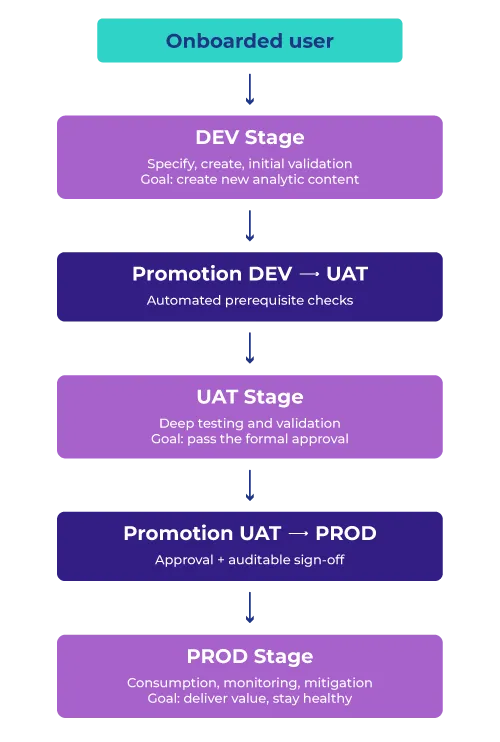
Two boundaries define the scope:
- The lifecycle begins once a user is onboarded and enters the DEV stage. Onboarding, licensing, and training are prerequisites; adjacent governance processes, not lifecycle stages.
- The lifecycle extends throughout the operational life of production content. Monitoring, re-certification, retirement, and platform health management are ongoing PROD responsibilities, not one-off steps.
Stage Details
Stage: DEV
The DEV stage exists to produce content that meets stated requirements and departmental standards, ready for formal validation. Its entry point is a documented requirement, covering the report, dashboard, dataset, semantic model or published data source, accompanied by risk tier and regulatory classification determined before development begins.
| Attribute | Detail |
|---|---|
| Goal | Produce content that meets the stated requirements and departmental standards, ready for formal validation. |
| Entry point | Documented requirement with risk tier and regulatory classification confirmed at intake. |
| Access & Audience | Restricted. DEV content is unvalidated and must not be exposed broadly. |
| Key personas | Creator, Power User (first-line DEV validation), BI Consumer (specification), BICC or BICOE Admin. |
Key activities in DEV:
- Requirement capture: regulatory classification, business context, technical specification, and expected deliverables.
- Development against tier-appropriate standards.
- Unit and smoke testing: general guidelines, basic performance, look and feel.
- Lineage and impact analysis: essential for datasets, semantic models, published data sources, where any change can ripple silently into downstream reports.
- Regulated-content processing (e.g. EUCT): sequential, not parallel. Where content meets the threshold for heightened regulatory treatment, those requirements layer on top of the standard lifecycle, adding heavier controls, not replacing standard ones.
Management activities:
- Regular synchronization with UAT to realign content that changed but was never promoted.
- Clean-up of abandoned content in the DEV workspace/environment (for example, not promoted and untouched for several months).
- Ownership reconciliation: no content should belong to creators who have left the company or changed teams.
Exit paths:
- Promotion: content is deployed forward through the Promote to UAT transition.
- Rework: content does not meet standards; feedback and fixes are required.
- On-hold: content is postponed or deprioritized.
- Clean-up: content is abandoned or superseded and is removed.
Transition: DEV to UAT
The transition is the auditable gate between stages. Its purpose is to validate that content is ready to leave DEV and to perform the promotion in a controlled, recorded way. Content is frozen for review from the moment the promotion request is raised until the decision is made.
| Attribute | Detail |
|---|---|
| Trigger | Explicit promotion request (ticket, change-management form, or equivalent) once development is complete. |
| Key checks | Business requirements met; documentation complete; unit and smoke testing passed; automated build and quality standards validated. |
| Decision | Go (promotion proceeds) or No-Go (content returns to DEV with documented reasons and an SLA for re-attempt). |
| Promotion act | Automated, via a service principal account. No human retains direct publish rights. |
Key activities in this transition:
- Validation that business requirements are met; without this, downstream testing has nothing to test against.
- Completeness of documentation.
- Confirmation that unit and smoke testing has been performed and passed.
- Automated validation of build and quality standards.
Stage: UAT
| Attribute | Detail |
|---|---|
| Goal | Validate content so that confident, regulated promotion decisions can be made. |
| Entry point | Successful DEV to UAT transition. Versioning and initial regression test run immediately on entry. |
| Access | Restricted to UAT testers and approving personas. |
| Key personas | User Acceptance/QA Tester, Creator (on standby for fixes), Compliance Officer (for sensitive content), BI Consumer Beta Testers (where applicable). |
Validation activities (run in parallel):
- Data quality and accuracy for published data sources, semantic layers, or semantic models.
- Data quality and accuracy for report and dashboard business rules.
- Data freshness and business logic metadata (formula and measure definitions).
- User experience: filter, parameter, and interaction testing.
- Usability and accessibility testing.
- User interface: visual theme, layout, branding standards.
- Access rights and security validation, particularly important for PII and sensitive financial data.
- Absolute performance: rendering time, interactivity duration, data volumes.
- Concurrent-user load testing with realistic concurrency profiles.
- Cross-browser and device compatibility.
- Data reconciliation against the authoritative source of truth.
- Cost efficiency: query design, extract sizing, and data model efficiency.
- Final regression testing: a second cross-environment pass documenting all changes against the pre-promotion baseline.
Catching an oversized model or a runaway query at the promotion gate is a FinOps control: it converts an open-ended operational liability into a one-time fix. The savings recur for as long as the report lives.
Separating always-required tests (data accuracy, calculation validation, security) from context-dependent tests (cross-browser, device compatibility) allows a bug fix to take a lighter path without weakening the safety standard for net-new content.
Exit paths:
- Successful completion: go to the Promote to PROD transition.
- Rollback to DEV: when any validation returns a No-Go or requires structural rework. For new content, the UAT instance is removed or invalidated.
Transition: UAT to PROD
The production transition is more deliberate than its DEV counterpart. The development-to-UAT transition can be agile and largely automated to keep the feedback loop tight. The production transition requires documented approvals, audit evidence, and a fully reconcilable decision trail.
| Attribute | Detail |
|---|---|
| Inputs | Full UAT validation reports, versioned artefact, documentation, and prior transition records. |
| Approvers | BICC or BICOE Admin (platform stability and capacity), Data Owner (data-source & data-usage appropriateness), Compliance Officer (regulated or sensitive content), BI Consumer Beta Testers (business fit), Technical Peer Reviewer (independent of the developer). |
| Decision model | Each approver produces a Go/No-Go with documented evidence. One approver, one decision trail. Final state: promotion, return to UAT, or return to DEV. |
| Promotion act | Automated, via a service principal account. No contributor to the build retains publish-to-production rights. |
| Rollback | Automated rollback capability with defined triggers: post-deployment performance degradation, unexpected data volumes, or critical defects in the first hours of production exposure. |
Stage: PROD
Production is the active stage, and the longest and most consequential phase of the analytics lifecycle, and it demands active management. The activities below are what separate a healthy, cost-efficient, trusted BI platform from one that slowly decays into an unmanaged archive; a risk with direct regulatory implications for any financial institution operating under OCC, Fed, or FFIEC oversight.
| Attribute | Detail |
|---|---|
| Goal | Deliver value by enabling consumers to make decisions on trusted content, while actively maintaining platform health, cost profile, and compliance. |
| Entry point | The transition from UAT to PROD is not just a promotion gate. It is the entry point into active governance: monitoring jobs are triggered, the asset is registered in the certification inventory, and consumers are notified. Production begins the moment the content lands, not after. |
| Version control & audit | Enterprise-grade version control activates at this point as well. Every change to a production asset, including the business logic behind every calculated field, is tracked, documented, and retained according to the retention obligations that apply to the content. For SOX-regulated reporting that means seven years. Unlimited version history and a complete, unbroken audit trail are not optional features in these environments. They are compliance requirements. |
| Access | Open to the intended consumer audience under the access controls defined in UAT. |
| Key personas | BI Consumer, Creator/UAT Tester (certification pipeline), BICC or BICOE Admin (platform health), BICC Member (governance and practice review), Power User/Champion (clean-up, archival, rollback). |
Continuous monitoring activities:
- Continuous certification: Recurrent validation of critical assets across three tiers. Bronze covers technical health: performance and standards adherence. Silver covers data freshness and targeted quality rules. Gold covers full validation, including data reconciliation, for critical or externally reported content. This full validation cycle directly addresses BCBS 239 Principle 7, which requires that risk management reports accurately and precisely convey aggregated risk data, reflect risk in an exact manner, and be reconciled and validated. Certification is what brings accountability: a current, visible trust signal that names an owner and withdraws automatically when validation lapses. Certification is also triggered by both cadence and event: upstream source changes, regulatory updates, and model changes. No critical asset sits in production unvalidated between cycles when the conditions that justified its last certification have materially changed. A static certification is a stamp applied once: it records that an asset passed on a given date and says nothing about its state today. The moment an upstream source, a measure definition, or a model changes, that stamp becomes a claim no one has verified, yet it still reads as trustworthy to every consumer who sees it. Wiiisdom’s dynamic certification applies to both published data sources/datasets/semantic models and dashboards/reports.
- Technical platform monitoring: Aggregated analysis of content impact on the platform, including predictive scoring that forecasts which assets are likely to cause performance issues before they become outages.
- Business platform monitoring: Ongoing application of design checks and best-practice rules in production to identify drift from standards and flag optimization candidates. A coaching posture scales better across a large community than a purely punitive one.
- Quarterly cadences: Quarterly performance review, certification strategy review, and clean-up of content that consumes platform resources without delivering value.
- Owner review: Reconciliation of content ownership against organizational and licensing changes. No production asset should exist without a named, still-employed owner accountable for it.
- Governance enforcement: Weekly application of policies to content that has breached standards: refresh suspension, quarantine, ownership notification, or deletion as appropriate.
Exit paths:
- Certified and in consumption: ongoing steady state.
- Planned decommissioning: flagged for retirement on a defined schedule.
- Archived: removed from active consumption but retained, typically for sensitive or regulated content that may be subject to future audit requests.
- Cleaned up: deleted when no longer needed and not subject to retention requirements.
- Returned to DEV: when a bug fix or enhancement is required, content re-enters the lifecycle from DEV through a lane appropriate to the scope of the change.
Personas
The following personas are active at different points in the lifecycle:
| Persona | Role in the lifecycle |
|---|---|
| Creator / Citizen Developer | Develops content against requirements and standards. |
| Power User / Champion | Team-level focal point, federated expert, first-line DEV validator before UAT begins. |
| User Acceptance Tester | Validates that content is fit for purpose against requirements and standards. |
| BI Consumer | The end user; provides requirements, consumes delivered content, and signals when content ceases to deliver value. |
| Compliance Officer | Required for critical, sensitive, high-impact, or externally-facing regulated content. |
| BICC/BICOE Member | Enforces governance, maintains standards, drives knowledge-sharing across communities of practice. |
| BICC/BICOE Admin or Platform owners | Manages platform health, cost, availability, and stability. |
| Security / Infrastructure Team | Provisions platform capabilities when requirements demand it. |
| Approver | Any persona holding Go/No-Go authority at a named gate; always distinct from the developer and the developer's direct report. |
Personas can play active roles (creating tests, adding validation) or passive roles (reviewing audit reports and issuing Go/No-Go).
Business Outcomes and KPI Framework
A BI path to production model creates value only if it improves measurable outcomes. For enterprise BI leaders, success should be evaluated not only by process adoption, but by the quality, control, and sustainability of the production estate.
Expected outcomes include:
- Reduced uncontrolled production change
- Stronger audit readiness
- Clearer ownership accountability
- Faster evidence-based promotion decisions
- More reliable trust signals on production assets
- Lower BI run costs through FinOps discipline: rationalization, policy enforcement, and cost-efficient content validation at the promotion gate.
Illustrative KPIs include:
- Percentage of critical production assets with current certification status
- Percentage of production assets with an active accountable owner
- Percentage of promotions with complete transition evidence
- Average time to approve DEV-to-UAT and UAT-to-PROD transitions
- Percentage of dormant, duplicate, or low-value content in production
- Time to detect drift after an upstream source, model, or logic change
These measures help move lifecycle management from a governance intention to a performance discipline. They also give executive sponsors a clearer basis to evaluate progress and prioritize investment.
Analytics Lifecycle Maturity Model
Organizations do not move from ungoverned analytics estates to continuous lifecycle control in a single step. Progress is usually incremental, and a maturity model helps teams understand both their current position and the next logical target state. In our experience, fewer than 15% of large financial institutions running self-service BI at scale operate above Level 2 at the point of first assessment. The blockers at each level are predictable and addressable.
Level 1: Ad hoc
Promotion is largely manual, ownership is incomplete, validation evidence is fragmented, and production trust depends heavily on individual effort. The primary blocker is the absence of any formal intake and classification process: without knowing what content is regulated or critical, it is impossible to apply proportionate controls.
Level 2: Controlled
Named environments and approval expectations exist, but execution remains inconsistent and difficult to audit. Evidence is present but not systematically collected or easily reusable. The primary blocker is manual evidence collection: governance teams cannot scale oversight when every promotion requires bespoke documentation effort.
Level 3: Automated
Promotion controls, evidence collection, and key validations are automated. Role separation is stronger. Production monitoring is active, and policy enforcement begins to scale. The primary blocker shifts from process to culture: federated teams resist centralized controls, and champion networks are not yet strong enough to carry governance into the business.
Level 4: Continuous Governance
Critical assets are tiered, monitored, re-certified, rationalized, and governed across their full production life. Production is treated as an actively managed portfolio. Governance is no longer a separate activity; it is embedded in the normal rhythm of analytics delivery.
Most organizations know they have a governance gap. This model helps them name it, locate it, and close it one level at a time.
90 / 180 / 365-Day Transformation Roadmap
A mature BI path to production does not require a multi-year redesign before any value appears. Organizations can sequence change in a way that delivers early control improvements while building toward continuous governance.
The sequence below reflects a general path. Organizations with active DFAST or CCAR obligations should prioritize ownership reconciliation and certification of risk-reporting assets in the first 90 days. SOX-focused organizations should prioritize transition evidence and version control for financial reporting content.
First 90 days
- Identify critical analytical assets
- Define intake classification and risk tiers
- Reconcile production ownership
- Establish baseline promotion controls and evidence expectations
By 180 days
- Standardize transition evidence
- Automate validation where possible
- Enable production monitoring and issue visibility
- Apply policy enforcement to the most critical gaps
By 365 days
- Implement tiered continuous certification
- Expand production observability
- Improve retirement and archival discipline
- Optimize run cost and platform capacity through portfolio rationalization
- Begin extending certification and ownership frameworks to AI-generated outputs inside governed BI platforms
This roadmap gives organizations a practical way to move from disconnected lifecycle activities toward an integrated operating model for trusted analytics.
How Wiiisdom Operationalizes the Model
Many organizations already have governance policies, standards, environments, and approval expectations. The challenge is not policy intent. The challenge is operational execution at scale. Without automation, evidence remains fragmented, production oversight becomes reactive, and governance teams struggle to keep pace with the growth of self-service analytics estates.
Wiiisdom operationalizes each stage and transition of this model directly on the platforms where analytics live, including Microsoft Power BI and Tableau. No rebuild of existing environments is required. No retraining of teams.
DEV stage:
Wiiisdom automates intake classification, enforces development standards, and generates evidence required to support the promotion request.
DEV to UAT transition:
Automated validation runs quality, performance, and standards checks, producing structured evidence that feeds directly into the Go/No-Go decision record.
UAT stage:
Wiiisdom supports data reconciliation, regression testing, and approval workflows with a full audit trail, ensuring that every promotion decision is documented and attributable.
UAT to PROD transition:
Promotion is executed via service principal, removing direct publish rights from any individual contributor. Version control activates on entry, with unlimited retention for SOX and other regulated content.
PROD stage:
Wiiisdom delivers continuous, patent-pending certification across bronze, silver, and gold tiers, triggered by both cadence and event. Reactive monitoring only confirms a failure after the user has already hit it: by then you are explaining a problem, not preventing one. Wiiisdom’s predictive monitoring reads the trajectory instead, degrading refresh times, growing volumes, rising concurrency, flagging the failure while there is still time to act. Governance policies are enforced on a regular cadence: refresh suspension, quarantine, ownership notification, and deletion. The production estate is treated as an actively managed portfolio, instead of an archive. Critically, all governance activities, including audit trail extraction, certification status review, version comparison, and promotion evidence, are accessible through a no-code interface designed for compliance officers, data owners, and business users who should never need IT involvement to demonstrate regulatory readiness. This is the shift from documented governance to continuous operational control.
By combining lifecycle structure with observability, certification, workflow discipline, and predictive monitoring, organizations can make the governed path the scalable path without relying on manual effort alone.
As AI tools generate outputs inside Power BI and Tableau at machine speed, Wiiisdom’s certification and monitoring capabilities extend naturally to those outputs, applying the same trust signals, ownership requirements, and validation discipline to AI-generated content that they apply to human-authored dashboards and reports today.
When Governance Has a Price Tag: A Real-World Case
At one of the largest banks in the world, a structured Analytics Governance initiative delivered a clear picture of what unmanaged BI estates actually cost. Across an enterprise analytics deployment of over 50,000 users, the audit revealed that more than half had not logged in during the year, representing direct licensing spend on accounts with zero activity. The content audit was equally striking: the majority of reports and documents stored on the platform were inactive, and 50+ terabytes of stored business content had not been accessed in over twelve months, carrying an annualized storage cost of $100,000+ that could be immediately decommissioned. Beyond storage, millions of documents containing business data were sitting in the analytics platform rather than in governed data repositories, creating both operational risk and compliance exposure for the lines of business.
The root cause was structural. Without a disciplined path to production, content entered the production environment without formal promotion gates, ownership assignment, or retirement criteria. There was no mechanism to distinguish actively used, business-critical analytics from dormant, ownerless, or duplicated content. Everything looked the same once it reached production, and nothing had a defined end of life.
The financial impact was concrete: $1M+ in annualized infrastructure savings, $1M in ELA savings, and a Year 2 ROI of 500% on the Analytics Governance tooling investment. The per-user licensing cost for the following year was cut in half as a direct result of the cleanup.
But the most important lesson was not the ROI. It was what happens next. A one-time cleanup, however thorough, is not governance. Without a repeatable, automated path to production enforcing promotion gates, ownership assignment, certification, and retirement policies on every new piece of content, the platform will accumulate the same liabilities again within months. The estate does not stay clean by itself. New content is published daily. Owners change. Projects end. Datasets drift. Without a structural and automated lifecycle discipline in place, the cleanup becomes a recurring cost rather than a solved problem.
This is not an edge case. In large BI estates, ungoverned content does not stay still. It accumulates, it drifts, and it costs money quietly, at a scale that only becomes visible when someone decides to look. A governed path to production does not just improve audit readiness. It prevents the estate from becoming a liability in the first place, and it keeps it that way.
The Next Chapter: Governing AI-Generated Analytics
The lifecycle framework described in this paper was built for a world where analytics content is created by humans, reviewed by humans, and promoted through human-approved gates. That world is not disappearing, but it is being joined by something fundamentally different, and most governance frameworks are not ready for it.
Every major technology wave in analytics history has added to what came before rather than replacing it. Reporting gave way to dashboards, dashboards gave way to self-service, and self-service is now being joined by AI-generated analytics. The consequence is not simplification. It is accumulation. More users, more use cases, more content, more exposure, more cost, and a regulatory environment that is only becoming more demanding. Governance, long treated as a constraint on speed, has become the condition for survival.
The new wave has two distinct forms, and they share a common unresolved problem.
The first is AI embedded inside existing BI platforms: Copilot in Power BI generating automated narratives and summaries, Tableau Pulse and Tableau Agent surfacing proactive anomaly alerts and insight recommendations, conversational agents answering business questions directly inside the tools organizations already deploy. These outputs land inside the governed BI environment and are consumed by the same business users, executives, and compliance stakeholders who rely on dashboards and reports today. In regulated financial services, some of them will influence capital decisions, risk positions, and regulatory filings.
The second is AI operating directly on the data layer: Databricks Genie, Snowflake Cortex, and their successors generating analytics outputs entirely outside the traditional BI platform. A business user asks a question in natural language and receives KPIs, charts, and narratives generated on the fly, with no developer, no UAT stage, and no promotion gate.
Both paths are accelerating. And both share the same governance gap.
The platforms racing to generate these outputs have invested heavily in what might be called input trust: semantic layer,[BM6.1] metadata governance, certified datasets. That foundation matters. But it is necessary, not sufficient. What the market has not yet solved is output trust: the validation of generated answers against certified business rules, the consistent certification of AI-produced insights before they reach a decision-maker, and the continuous monitoring of whether those answers remain correct, consistent, and safe to act on over time. The same question asked twice should produce the same answer. A narrative generated for a CFO should carry a signal indicating whether it has been reviewed and validated. An anomaly alert surfaced by an AI agent should have an owner accountable for its accuracy. Today, none of that exists in any platform or governance tool in a systematic way.
This is not a hypothetical gap. It is the next version of the same problem the analytics industry has been managing for twenty years. Before, the challenge was that too many dashboards were built without governance, drift went undetected, and ownership was unclear. The industry built tools to address that, including the framework described in this paper. Now, AI is generating insights at machine speed, the volume of unvalidated outputs is growing exponentially, and the same silent failure mode applies: an answer that looks precise, gets acted upon, and turns out to be wrong, with no audit trail and no accountability.
The organizations that will navigate this transition most effectively are not those trying to slow AI adoption. They are those that extend the same production discipline they apply to dashboards and reports to every AI-generated output their users consume. The lifecycle principles described in this paper, ownership, certification, evidence, and continuous monitoring, do not become obsolete in an AI-augmented environment. They become more important.
Conclusion
For organizations operating under formal regulatory obligations, whether financial reporting requirements under SOX that apply to any public company, safety and quality standards in pharma, aerospace, automotive, or manufacturing, or prudential and conduct obligations in financial services, the stakes are clear. And for financial institutions in particular, where analytics feed stress testing, regulatory capital calculations, compliance reporting, and executive certification, the margin for error is zero. Errors in analytics content can affect regulatory filings, critical operational decisions, and financial risk positions. The frameworks that govern BI content must be proportionate to those stakes, but they must also be practical enough that teams use them rather than avoid them. The BI path to production presented in this paper is designed to be both.
The hidden cost of ungoverned analytics is not only financial. Every DFAST cycle, every SOX audit, every OCC examination that requires manual evidence reconstruction, last-minute reconciliation, or emergency ownership clarification represents hours of effort that a governed lifecycle would have eliminated. The question is not whether your organization can afford to operationalize analytics governance. It is whether it can afford not to.
If you cannot answer today who owns your most critical production BI assets (dashboards or reports), when it was last validated, and what would happen if its upstream source changed tonight, you already have a governance gap. The only question is whether you find out on your terms, or on your regulator’s.